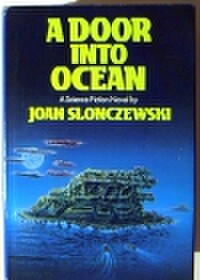
Review of A Door into Ocean by Joan Slonczewski (Fic SLO)
Reviewed by Alex Roberts
Ever heard of Quaker science fiction? In 1986, Joan Slonczewski published a novel set on the distant aquatic planet of Shora, whose inhabitants resist an extractive military-colonial force with the power of nonviolent resistance. Some parts of it will feel familiar to Friends, and not just because the amphibious people of Shora, called “Sharers,” seem to be organized around a seafaring system of Monthly Meetings!
The story begins with a young man, a citizen of the colonial empire, who is brought to Shora by two Sharers who want to see if an outsider can learn their ways and live among them. He does, slowly, adapt to a culture built on simplicity, peace, integrity, community, and stewardship, and finds ways to help defend and support the Sharers from their invaders. Don’t expect a “messianic” trope here, however. His role in the Sharer’s resistance is relatively minor, as the narrative shifts more and more to the Sharers and their internal conflict and struggle to maintain their egalitarian society and ecological balance in the face of overwhelming power.
The author, also a microbiologist, blends a painfully detailed description of ecological destruction with imaginative speculative biology. For example, I loved her description of Sharers developing a morse code-like messaging system via a symbiotic species of insect! It’s a memorable book, and not just because of its ecofeminist, anti-war, anti-colonial, and scientific themes. I would recommend A Door into Ocean to anyone who enjoys well-written novels with unique ideas and deep characterization.
I hope to make Slonczewski’s other, more explicitly Quaker, sci-fi novel Still Forms on Foxfield the subject of a future review.
[It is the first book in the Elysium series — see Wikipedia entry]
Book Review: This is Real and You Are Completely Unprepared…
Matthew Manera’s Review of This is Real and You Are Completely Unprepared. The Days of Awe as a Journey of Transformation by Rabbi Alan Lew (296.43 LEW)
At first glance, this is a book about the Jewish High Holidays, and, of course, it is. But though it addresses the specific holidays, from Tisha B’Av [the day of mourning for the destruction of the Temple in Jerusalem] to Sukkot [the autumnal harvest festival], it speaks to anyone who is concerned with spiritual transformation.
All significant religious texts will overlap in some degree when it comes to the most substantial understanding of what the relationship between the human and the divine, or between a disciple and a teacher, is (Rabbi Alan Lew, before becoming a Rabbi, spent ten years as a committed practitioner of Zen Buddhist meditation). For example, in the Bhagavad Gita, Krishna says to Arjuna, “No matter by what path men approach Me [you can read “Me” to be your own understanding of God], they are made welcome. For all paths no matter how diverse lead straight to Me. All paths are mine, notwithstanding by what names they may be called.” And when the Buddha was addressing the inhabitants of the small town of Kesaputta, he said, “Now, look you Kalamas, do not be led by reports of religious texts, nor by mere logic or inference, nor by considering appearances, nor by the delight in speculative opinions, nor by seeming possibilities, nor by the idea: ‘this is our teacher.’ But, O Kalamas, when you know by yourselves that certain things are unwholesome and wrong and bad, then give them up […] And when you know for yourselves that certain things are wholesome and good, then accept them and follow them.” This reminds me of two passages from George Fox’s Journals: he said about his faith, “And this I knew experimentally,” and about the teachings of Christ, “You will say, Christ saith this, and the apostles say this; but what canst thou say?”
Here are some passages (some quoted directly; some paraphrased) from the book that might entice you into engaging in a dialogue with it:
• Spiritual practice will not change what happens to us; rather, it will change us.
• [with reference to being called to account for our actions, feeling that we are ready and confident to do so, but finding that we are, unexpectedly, completely unprepared] “And [this sense of being completely unprepared] is real whether you believe in God or not. Perhaps God made it real and perhaps God did not. Perhaps God created this pageant of judgment and choice, of transformation, of life and death. Perhaps God created the Book of Life and the Book of Death, Teshuvah and the blowing of the shofar. Or perhaps these are all just inventions of human culture. It makes no difference. It is equally real in any case.”
• “Perhaps God made the reality that all this human culture seeks to articulate. Perhaps God made a profoundly mixed world, a world in which every second confronts us with a choice between blessings and curses, life and death; a world in which our choices have indelible consequences; a world in which life and death, blessings and curses, choose us, seek us, find us every moment. And we live with the consequences of our choices. And perhaps we have chosen arbitrary spiritual language to express these things, or perhaps God made human culture so that we would express these things precisely as we have in every detail. It makes no difference. What makes a difference is that it’s real and it is happening right now and it is happening to us, and it is utterly inescapable, and we are completely unprepared. This moment is before us with its choices, and the consequences of our past choices are before us, as is the possibility of our transformation.”
• “The first thing we do during the High Holidays is come together; we stand together before God as a single spiritual unit. […] We heal one another by being together. We give each other hope.”
• “Most of us only embark on the difficult and wrenching path of transformation when we feel we have no choice but to do so, when we feel as if our backs are to the wall, when the circumstances of our lives have pushed us to the point of a significant leave-taking, when we have suffered loss or death, divorce or unemployment. Transformation is just too hard for us to volunteer for. […] We are in the predicament that has brought us to the point of transformation because God has driven us there. In other words, that predicament is part of the process. It is a gift, the agent of our turning. […] Transformation is not something that happens once and for all time. […] Transformation does not have a beginning, a middle, or an end. […] And it may never be clear to us that the work of transformation has borne fruit […] Real spiritual transformation invariably takes a long time to manifest itself in our lives.”
• [Lew quotes from Shunryu Suzuki, in his book Zen Mind, Beginner’s Mind] “If your mind is empty, it is always ready for anything; it is open to everything. n the beginner’s mind there are many possibilities; in the expert’s mind there are few […] In the beginner’s mind there is no thought, ‘I have attained something.’ All self-centred thoughts limit our vast mind. When we have no thoughts of achievement, no thought of self, we are true beginners.”
• “Every spiritual tradition I am aware of speaks of a kind of layered mindfulness, a sensibility that works up and out of the body, to the heart and then to the mind and then finally to the soul. The Buddhist sutra On Mindfulness describes this kind of layered grid of awareness, and the Kabala, the Jewish mystical tradition, speaks of it too.”
• “None of us is whole by ourselves. A spiritual community is one in which we find wholeness, completion with others. What we lack is provided by somebody else.”
• [on death] “We are born and we die, and nothing that happens in between is nearly as important as these two fundamental facts of life. […] Once life is over, it is clear that it has taken up no time or space at all. […] What lives on of the people we have loved and lost? What breaks our hearts when we think of them? What do we miss so much that it aches? Precisely that suchness, that unspeakable, ineffable, intangible quality, which takes up no space at all and which never did.”
• “What is the core of our life? Are we living by it? Are we moving toward it? We shouldn’t wait until the moment of our death to seek the answers. At the moment of death, there may be nothing we can do about it but feel regret. But if we seek answers now, we can act in the coming year to bring ourselves closer to our core.”
• “We can’t control sickness, old age, or death. We are terrified of them. But as Sharon Salzberg asks, what would we fear if we experienced ourselves to be part of the whole of nature, moving and changing, being born and dying? What would we fear if we understood that our bodies were joined with the planet in a continual, rhythmic exchange of matter and energy?”
• “Joy is a deep release of the soul, and it includes death and pain. Joy is any feeling fully felt, any experience we give our whole being to.”
• “Every moment of my life, I am inescapably hammered into place by everything that has ever happened since the creation of the universe, and every moment I am free to act in a way that will alter the course of that great flow of being forever.”
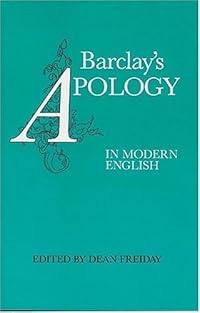
Matthew Manera’s Review of “Barclay’s Apology in Modern English (289.6 BAR)” July 2025
“What I have written comes more from what I have heard with the ears of my soul. I have declared what my inward eyes have seen and what my hands have handled of the Word of Life. It is what has been inwardly manifested to me of the things of God.” So writes Robert Barclay at the beginning of his Apology, which consists of fifteen theological theses, or propositions, published in 1676 in Latin, then in English in 1678. It should be noted that this edition of the Apology is rendered into modern English by Dean Freiday and is an abridged and edited edition, which some scholars have criticized in parts for misrepresentation of Barclay’s ideas. Barclay makes many references to Christ, which, given the beginnings of Quakerism in the Christian tradition, is inescapable. However, for those Quakers who do not consider themselves bound by the Christian tradition, one can read “Christ” as “Spirit,” and still find these propositions speak to their condition.
Proposition 1, “The True Foundation of Knowledge,” serves as an introduction to the following fourteen propositions: “Since the height of all happiness is the true knowledge of God, it is primary and essential that this foundation of knowledge be properly understood and believed.”
In Proposition 2: “Inward and Unmediated Revelation,” Barclay insists that divine inward revelations and inward illuminations are “absolutely necessary for the building up of true faith” and “possess their own clarity and serve as their own evidence.”
As for the Scriptures, which he addresses in Proposition 3, they are “only a declaration of the source, and not the source itself” and “are not to be considered the principal foundation of all truth and knowledge,” but only “as a secondary rule that is subordinate to the Spirit.”
In Proposition 4, “The Condition of Man in the Fall,” Barclay argues against the Augustinian-based concept of original sin, writing that “we do not impute the evil seed to infants until they have actually been joined to it by their own transgression.”
Freiday puts Propositions 5 and 6 (“The Universal Redemption by Christ, and also the Saving and Spiritual Light by which Every Man is Enlightened”) together in one chapter. Proposition 5 refers to the Fall of Man (Proposition 4) by pointing out “the real light which enlightens every man,” which is Christ, and according to John 1:9, “is no less universal than the seed of sin, being purchased by his death who tasted death for everyone.” In Proposition 6, Barclay argues that “the universality of Christ’s saving death” is available to everyone in every time: “Just as many of the ancient philosophers may have been saved, so may some of those today whom providence has placed in remote parts of the world where the knowledge of history [i.e. the historical Jesus] is lacking, be made partakers of the divine mystery if they do not resist the manifestation of grace which is given to everyone for his benefit. […] The benefit of [Christ’s] suffering is extended not only to those who have a well-defined outward knowledge of his death and sufferings, […] but even to those who by some unavoidable accident were excluded from the benefit of this knowledge.”
Proposition 7 deals with Justification, which Barclay defines as “the formation of Christ within us, from which good works follow as naturally as fruit from a fruitful tree.” We are justified, therefore, “not by works produced by our own wills, or by good works themselves, but by Christ, who is not only the gift and the giver, but the cause which produces these effects in us.”
Perfection [or The Achievement of Spiritual Maturity] is the theme of Proposition 8. Barclay makes clear that by Perfection, he means something “that is proportional to a man’s requirements.” When, in this state of relative perfection, one “is no longer able to obey any suggestions or temptations toward evil, but is freed from sin and the transgression of the law of God, and in that respect is perfect.”
Proposition 9, “Perseverance in the Faith and the Possibility of Falling from Grace,” is the consequent counterpart to Proposition 8, in that “even though this gift of the inward grace of God is sufficient to bring about salvation, yet for those who resist it, it not only may become their condemnation, but does. […] Nevertheless, it is possible to achieve […] an increase and stability in the truth in this life that total apostasy is impossible.”
Ministry, the subject of Proposition 10, presents Barclay’s, and Quakers’, understanding of how ministry should be understood: “Every evangelist and every Christian pastor ought to be led and directed in his labour in the work of the gospel by the leadings, motions, and drawings of God’s light. These should govern not only the place where, but the persons to whom he speaks, and the time when he should speak. […] Those who have received this holy and unspotted gift [of ministering] have received it without cost and should give it without charge.” One should keep in mind that, at the time Barclay is writing, itinerant ministers, especially among Quakers, were common.
In Proposition 11, “Worship,” Barclay writes of all those Quakers who are not called to be itinerant ministers, while hearkening back to the subject of Proposition 2: “True and acceptable worship of God stems from the inward and unmediated moving and drawing of his own Spirit. It is not limited by places, times, or persons. […] We should be moved by the secret stimulation and inspiration which the Spirit of God provides in our hearts.”
Barclay addresses Baptism in Proposition 12, by citing Ephesians 4:5 and 1 Peter 3:21: “Just as there is ‘one Lord, and one faith,’ so is there ‘one baptism,’ which is ‘an appeal to God for a clear conscience, through the resurrection of Jesus Christ.’” He points out, as well, that “the baptism of infants, however, is [unlike the figurative baptism of John] a mere human tradition, for which neither precept nor practice is to be found anywhere in scripture.”
Communion, another of the Christian sacraments, like Baptism, is the subject of Proposition 12: “The communion of the body and blood of Christ is inward and spiritual. It is by participation in his flesh and blood that the inward man is nourished daily in the hearts of those in whom Christ dwells.”
Proposition 14, “Concerning Civil Power [“the power of the Civil Magistrate” in the original] in Matters Purely Religious and Pertaining to the Conscience,” argues that one’s own conscience, derived from God, is to be regarded more highly than any civil power: “The power and dominion of the conscience are the province of God, and he alone can properly instruct and govern it. No one whatsoever may lawfully force the consciences of others regardless of the authority or office he bears in the government of this world.” That being said, this is “always subject to the provision that no man, under pretense of conscience, may prejudice the life or property of his neighbour, or do anything that is destructive to human society or inconsistent with its welfare.”
Lastly, Proposition 15 deals with “Vain and Empty Customs and Pursuits.” “The chief purpose of all religion,” writes Barclay, “is to redeem men from the spirit and vain pursuits of this world, and to lead them into inward communion with God. All vain and empty customs and habits [for example, “taking one’s hat off to another person, bowing or cringing], whether of word or deed, should be rejected by those who have come to fear the Lord [fear being understood as awe].”
Review: Man’s Search for Meaning by Viktor E. Frankl
Review: Man’s Search for Meaning by Viktor E. Frankl (150.195 FRA) by Matthew Manera June 2025
This book by Frankl, a leading European psychiatrist in the mid-twentieth century, originally written in 1946, is in three parts: “Experiences in a Concentration Camp; “Logotherapy in a Nutshell”; and “The Case for Tragic Optimism,” a postscript written in 1984.
Part One: Experiences in a Concentration Camp
Frankl explains at the outset that this section answers the question, “How was everyday life in a concentration camp reflected in the mind of the average prisoner?” He observes that there were three phases of the inmate’s mental reactions to camp life: “the period following his admission; the period when he is well entrenched in camp routine; and the period following his release and liberation.”
The first phase was characterized by shock, which was soon followed by a “delusion of reprieve,” in which the prisoner believes that he will be “reprieved at the very last minute.” Eventually, as Frankl says of himself as a prisoner, “I struck out my whole former life,” for “the illusions some of us still had were destroyed one by one, and then, quite unexpectedly, most of us were overcome by a grim sense of humour.” The second phase was one of “relative apathy in which [the prisoner] achieved a kind of emotional death” which made him “insensitive to daily and hourly beatings.” In spite of this, “it was possible for spiritual life to deepen.” It was in this phase that Frankl came to realize three things: that “love is the ultimate and the highest goal to which man can aspire”; “that everything can be taken from a man but one thing: the last of the human freedoms—to choose one’s attitude in any given set of circumstances, to choose one’s own way”; and that “if there is a meaning in life at all, then there must be a meaning in suffering.” As Nietzsche wrote, “He who has a why to live for can bear with almost any how.” In the third phase, “what was happening to the liberated prisoners could be called ‘depersonalization.’ Everything appeared unreal, unlikely, as in a dream. We could not believe it was true.” On being set free, “only slowly could these men be guided back to the commonplace truth that no one has the right to do wrong, not even if wrong has been done to them.” “Two other fundamental experiences threatened to damage the character of the liberated prisoner: bitterness and disillusionment when he returned to his former life.” nd, finally, “The crowning experience of all, for the homecoming man, is the wonderful feeling that, after all he has suffered, there is nothing he need fear any more—except his God.”
Part Two: Logotherapy in a Nutshell
Part One, concerning his life in a concentration camp, is a kind of preface to Part Two, an explanation of Logotherapy, which Frankl developed and which is the most important part of the book. Logos denotes meaning. Logotherapy, then, “focuses on the meaning of human existence as well as on man’s search for such a meaning.” It speaks of a will to meaning, as opposed to the Freudian will to pleasure, and the Adlerian will to power. Frankl argues that mental hygiene depends not on an achievement of equilibrium, but rather on “the striving and struggling for a worthwhile goal, a freely chosen task.” This, he calls noö-dynamics (noös meaning “mind”): “the existential dynamics in a polar field of tension where one pole is represented by a meaning that is to be fulfilled and the other pole by the man who has to fulfill it.” “What matters […] is not the meaning of life in general but rather the specific meaning of a person’s life at a given moment.” In the end, it is the responsibility of each person to answer for their own life. The categorical imperative of logotherapy is, “Live as if you were living already for the second time and as if you had acted the first time as wrongly as you are about to act now.”
Frankl says that, according to logotherapy, we can discover the meaning in life (a meaning that always changes, but never ceases to be) in three ways: “(1) by creating a work or doing a deed; (2) by experiencing something or encountering someone (no one can become fully aware of the very essence of another human being unless he loves him); and (3) by the attitude we take toward unavoidable suffering.”
He also argues against what he calls “pan-determinism”: “the view of man which disregards his capacity to take a stand toward any conditions whatsoever (biological, psychological and sociological conditions, or the product of heredity and environment). Man is not fully conditioned and determined but rather determines himself whether he gives in to conditions or stands up to them.”
Part Three: The Case for a Tragic Optimism
Much of this chapter repeats points he made in Part Two. He does introduce, however, the concept of tragic optimism, which, according to Frankl, means that “one is, and remains, optimistic in spite of […] those aspects of human existence which may be circumscribed by: (1) pain; (2) guilt; and (3) death.” One must have optimism in the human potential which allows for: “(1) turning suffering into a human achievement and accomplishment; (2) deriving from guilt the opportunity to change oneself for the better; and (3) deriving from life’s transitoriness an incentive to take responsible action.”
Lastly, Proposition 15 deals with “Vain and Empty Customs and Pursuits.” “The chief purpose of all religion,” writes Barclay, “is to redeem men from the spirit and vain pursuits of this world, and to lead them into inward communion with God. All vain and empty customs and habits [for example, “taking one’s hat off to another person, bowing or cringing], whether of word or deed, should be rejected by those who have come to fear the Lord [fear being understood as awe].”
It’s the time of year when the thoughts of Friends in Western Canada and beyond turn to that most magical of gatherings, Western Half Yearly Meeting. We are excited to be holding our Spring gathering at Sorrento, BC, on beautiful Shuswap Lake, and on-line, on the coming May Day long-weekend, Friday, May 16th to Monday, May 19th.
To Friends and attenders who have not been to our gathering, this is a unique opportunity to meet Friends from BC to Saskatchewan, and sometimes beyond, and to worship with, and learn from, one another. If you are able to make the trip, or to join us on-line, we’d love to show you why so many Friends come back year after year.
I’d like to invite Friends who have been before to take a moment to think about a Friend that you think would enjoy WHYM and talk to them about the gathering and why they should attend.
What you’ll find at WHYM
As usual, we’ll have time for worship, both in small and as a large group, intergenerational activities, and times to learn together. Singing and balancing (group gymnastics) and our childrens’ and teens’ programs provide fellowship for kids and youth, while freeing parents to participate in the broader gathering. Here’s the draft schedule. Please take a look, and feel free to email if you have questions.
In reading the Schedule, please keep in mind that all times are in Pacific Time, consistent with the time zone for Friends gathering in Sorrento.
If you’re joining us in person, the Sorrento Centre is a beautiful space, with a waterfront area on Shuswap Lake, accommodation ranging from private rooms to cabins to a bed in a shared cabana.
Friends who are attending on-line are asked to pay a suggested $15-20 per person attending, reflecting the costs to hold a hybrid event. Friends seeking to participate in on-line Worship Sharing will need to register by Tuesday, May 13th (see below if you are not familiar with this term). Otherwise registration for the on-line Gathering may occur until the start of Meeting.
The deadline for Friends attending in person is Friday, April 25th.
Friends are invited, in registering, to propose one or more Special Interest Groups (see below if you’re not familiar with this term). Special Interest Groups are an opportunity to share or invite discussion on topics of interest. No training is necessary – just an excitement to explore a topic. Those present at Sorrento should think about whether and how Friends joining on-line can be included.
We recognize that coming in person to Sorrento can be a major undertaking, both in terms of time and financially. If cost is a barrier to your participating, please note:
Tenting, booking a single bed in a shared cabana or arranging to share a cabana with other Friends are all cost effective choices for accommodation. Carpooling with Friends coming from your Meeting or Worship group may also be helpful.
There is financial support available to Friends who would otherwise have difficulty travelling or attending. If at all possible, please ask your Monthly Meeting for support (talk to your Clerk) and for a letter asking Western Half Yearly Meeting for support.
If you are coming from Saskatchewan or further east, Friends often stay with Calgary Friends en route. If you don’t know anyone in Calgary to ask, feel free to email me, and I’ll put you in touch with Calgary Friends who may be willing to host.
As in recent years, we ask Friends attending in person to test for COVID before coming, and not to come if you test positive. Friends attending in person will be asked to mask during indoor portions of the Gathering.
If there is anything else we can do to help you feel welcome or to take the risk of making this trip, please feel free to email me.
A special welcome to new (or newish) WHYM attenders
Coming to a long-standing gathering can be intimidating, but we hope that you will give this gathering a try. There are few opportunities in Western Canada to meet Friends outside our own Meetings, and WHYM is a unique opportunity to worship, learn, play and share together. We aim to be a loving community to people of all ages, backgrounds, races and sexual identities. You are more than welcome to join us on-line to see what it’s about, and if you’re ready to come to Sorrento, we look forward to meeting you in person at our gorgeous location.
A note about a couple of terms used in the schedule, above:
Worship Sharing or Fellowship – Worship sharing is a “contemplative spiritual practice” in which a small group of 4-8 people settle into a worshipful silence, and share together, “speak[ing] from their own experience with thoughtful pauses.”
Special Interest Groups (SIG) – Any person attending WHYM may propose a Special Interest Groups as a space for Friends to explore an issue, activity or concern as a group. Sometimes the Friend hosting a SIG will offer instruction or initial thoughts, but often the Friend is merely identifying a topic for discussion or discernment. Friends self-select which SIG they will attend.
If you have any questions or concerns about the gathering, feel free to reach out to me at whym-clerk@quaker.ca.
A final request:
Please extend this invitation to any Friend(s) or attenders you think might be interested in attending Western Half Yearly Meeting, along with a few words about why you think that they should consider joining us.
Payments go by e-transfer to WHYMpayments@viquakers.ca (if you registered early, you may have received a different, incorrect address – we apologise!).
Updated Clerk’s letter (Wednesday May 14, 2025)
Dear Friends,
We are looking forward to seeing you this weekend. I wanted to reach out before we all leave to make sure that you have a few key pieces of information.
Second, a reminder of some expectations. Friends are asked to abide by the CYM Community Agreement. As in years’ past, since Covid is still out there, please test before coming and do not come if you test positive. We are asking adult Friends to mask in the main indoor gatherings. Smaller groups can discuss among themselves, but we trust that Friends will respect the wishes of any Friends who feel safer with masking.
Third, Friends are encouraged to bring along some snacks to share at the snack time. These should be left in the small kitchen in Caritas (the building with our main meeting room).
Again, we are thrilled to be gathering again, please travel safe, and see you all soon.
In Peace,
Rachel Rachel Singleton-Polster Clerk, Western Half Yearly Meeting
Invitation from the Clerk of WHYM (April 5th, 2025)
The original invitation is here (from April 5, 2025).
Vancouver Island Monthly Meeting of the Religious Society of Friends, in Victoria, BC, is seeking applicants for the position of Resident Friend, for a term of 3 years, renewable once, commencing no later than September 1st, 2025.
The role includes responsibility for meeting the public, assisting with rentals and other enquiries; janitorial duties; liaison with the Quaker community. Computer skills are essential (email; handling online rental bookings; calendaring).
The role is unpaid; compensation is provided in a 1-bedroom, unfurnished suite that is part of the Heritage Meeting House. Shared Hydro; internet provided; garden access; in-suite laundry; one parking space. Non-accessible accommodation. Additional space may be available by negotiation.
Further information may be obtained from the Resident Friend Search Committee: clerk@viquakers.ca.
To apply send resume and 2 references by email to VIMM clerk by June 30, 2025. Position only open to those with Canadian citizenship or Permanent Resident status in Canada.
To support the work of the Friends Women’s Association in Burundi:
Canadian Monthly Meetings MAY SOON be able to get tax receipts for furthering the work of Friends Women’s Association Burundi by contributing to the shipping costs of a container of medical supplies to be sent to Burundi by Compassionate Resources Warehouse (an NGO charity out of Victoria, BC): https://www.crwarehouse.ca/
Friends Peace Teams: https://friendspeaceteams.org/donate/ You can choose to direct your donation to the FWA’s work in Burundi. Please note CFSC is not a current financial partner of FWA
Page updated on Thursday September 26th. This update contains information about Fall 2024 WHYM
Please note: in-person registration closes Tuesday October 1st. To participate in online Worship Sharing please register by Saturday October 4th. Apologies from the web team for late posting.
Dear Friends,
With Fall in the air, can Thanksgiving and Western Half-Yearly Meeting (WHYM) be far off!? It’s time to make your plans to join in the richness of Quaker community.
This WHYM will again have 3 components: online, in person, and hybrid (online access to in person sessions). The hybrid portion may not be as stellar as last year as we no longer have our super tech.
WHYM is Friday evening October 11 to Monday morning October 14, 2024 (Thanksgiving weekend)
In Person:
Here is the information for the in person gathering taking place at Camp Kannawin on Sylvan Lake, near Red Deer Alberta. This is where we met last fall. Please read this information sheet carefully.
Here is theregistration form to attend in-person – Note: in-person registration closes October 1st if you want to eat, sleep, or be in Worship-Sharing groups.
Reviews should be a maximum of 2 pages long, single-spaced, Tahoma, 12 pt. The title of the book you are reviewing should include the call number (Dewey Decimal number or Fiction call) found on the spine of the book. As librarian, I will do any necessary editing for grammar, spelling, punctuation, etc. and mail it to you for approval before sending it to the Fern Street News editor for posting. If you have any further questions about the process, email Matthew.
Religious Schism in Early Nineteenth Century America By Robert W. Doherty (289.6 DOH) This book traces the sociological or societal, as well as the religious, issues, particularly in the Philadelphia area of 19th century America, that led to the so-called Hicksite Separation (named after Elias Hicks) of 1827. Doherty points out that the early 19th century Quakers in and around Philadelphia headed towards this separation because they “lacked any institutional means for resolving conflict.” There were problems with methods of appointment and with jurisdiction, and with the fact that all decisions were supposed to be unanimous. As for their… Read more: The Hicksite Separation: A Sociological Analysis of
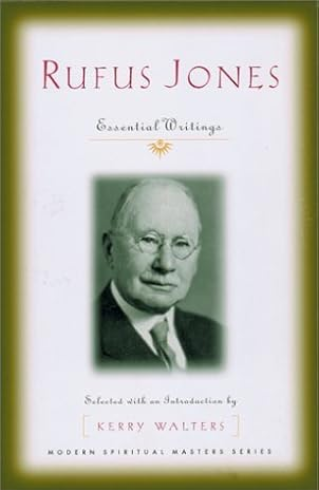
Selected with and Introduction by Kerry Walters (289.6 JON) At his birth in Maine in 1863, Rufus Jones’s Aunt Peace said of him, “This child will one day bear the message of the Gospel to distant lands and to peoples across the sea.” And so, he did. By the time he was four years old, he said that he “had formed the habit of using corporate silence in a heightening and effective way.” In his undergraduate years at Haverford College, he studied religion, philosophy, and history, and wrote his senior thesis on mysticism. In 1917, he was one of… Read more: Rufus Jones. Essential Writings
If, as a librarian, I allow myself some time to muse about libraries, it is only fitting that I begin with reference to the great Library at Alexandria in Egypt, which is believed to have been instituted by Ptolemy II, pharaoh and basileus of the Ptolemaic Kingdom, sometime in the 3rd century BCE. It formed part of the Mouseion, a place dedicated to the Muses. At its height, it is said to have contained up to 400,000 papyrus scrolls. At their best, libraries, of whatever size and grandeur, are repositories of the human endeavour to know about our world,… Read more: A Librarian Muses about Libraries
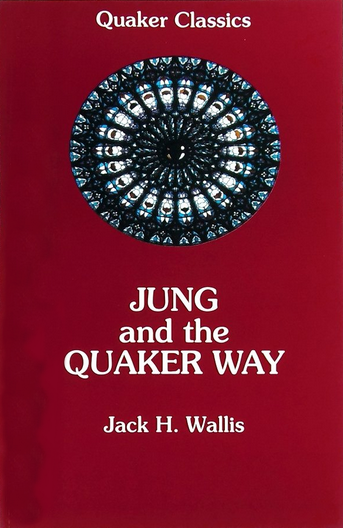
If you’re familiar with Quaker practice, but not with the psychological principles of Carl Jung, this book is a good introduction to Jung, as well as being an interesting perspective on the intersection of his principles with Quakerism. Jung, like Quakers, believed “that any true religion should be founded on experience, not on dogma, doctrine or a dutiful faith.” Jung had little interest in theology, but an intense interest in religion. He maintained, as Wallis says, that it is “the province of religion and psychology to work together in helping individuals towards integration, balance, and wholeness.” Wallis, via Jung,… Read more: Jung and the Quaker Way by Jack H. Wallis (289.6092 WAL)
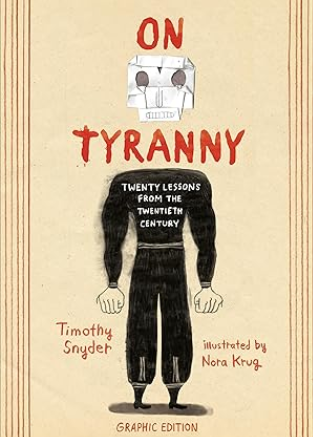
Reviewed by Matthew Manera. Though this book was published in 2017 and deals with the aftermath of Trump’s election in 2016, it applies just as well, perhaps even more so, to where we are in 2025. Snyder begins with a Prologue on History and Tyranny to set the stage for the rest of the book. The second of these twenty lessons is “Defend Institutions,” in which he writes, “The mistake is to assume that rulers who came to power through institutions cannot change or destroy those very institutions—even when that is exactly what they have announced that they will do.”… Read more: On Tyranny: Twenty Lessons from the Twentieth Century By Timothy Snyder (321.9 SNY)
Reviewed by Matthew Manera. Brinton’s overview of Quakerism, unlike Elfrida Vipont’s The Story of Quakerism 1652-1952 and Ben Pink Dandelion’s An Introduction to Quakerism, “is not”, as Brinton says in his Introduction, “to produce a history of Quakerism, but, by means of historical illustrations, to examine a method.” In this way, it is a useful complement to these two books. Brinton examines early Quakerism by focusing on George Fox’s pastoral Epistles and Robert Barclay’s Apology, the former portraying “Quakerism as felt,” or experienced; the latter portraying “Quakerism as thought about.” I’m trusting that those of you who read this are… Read more: Review: Friends for 300 Years by Howard H. Brinton (289.6 BRI)
Reviewed by Alex Roberts Ever heard of Quaker science fiction? In 1986, Joan Slonczewski published a novel set on the distant aquatic planet of Shora, whose inhabitants resist an extractive military-colonial force with the power of nonviolent resistance. Some parts of it will feel familiar to Friends, and not just because the amphibious people of Shora, called “Sharers,” seem to be organized around a seafaring system of Monthly Meetings! The story begins with a young man, a citizen of the colonial empire, who is brought to Shora by two Sharers who want to see if an outsider can learn their… Read more: Review of A Door into Ocean by Joan Slonczewski (Fic SLO)
Matthew Manera’s Review of This is Real and You Are Completely Unprepared. The Days of Awe as a Journey of Transformation by Rabbi Alan Lew (296.43 LEW) At first glance, this is a book about the Jewish High Holidays, and, of course, it is. But though it addresses the specific holidays, from Tisha B’Av [the day of mourning for the destruction of the Temple in Jerusalem] to Sukkot [the autumnal harvest festival], it speaks to anyone who is concerned with spiritual transformation. All significant religious texts will overlap in some degree when it comes to the most substantial understanding of… Read more: Book Review: This is Real and You Are Completely Unprepared…
Matthew Manera’s Review of “Barclay’s Apology in Modern English (289.6 BAR)” July 2025 “What I have written comes more from what I have heard with the ears of my soul. I have declared what my inward eyes have seen and what my hands have handled of the Word of Life. It is what has been inwardly manifested to me of the things of God.” So writes Robert Barclay at the beginning of his Apology, which consists of fifteen theological theses, or propositions, published in 1676 in Latin, then in English in 1678. It should be noted that this edition… Read more: Book Review: Barclay’s Apology in Modern English
Review: Man’s Search for Meaning by Viktor E. Frankl (150.195 FRA) by Matthew Manera June 2025 This book by Frankl, a leading European psychiatrist in the mid-twentieth century, originally written in 1946, is in three parts: “Experiences in a Concentration Camp; “Logotherapy in a Nutshell”; and “The Case for Tragic Optimism,” a postscript written in 1984. Part One: Experiences in a Concentration Camp Frankl explains at the outset that this section answers the question, “How was everyday life in a concentration camp reflected in the mind of the average prisoner?” He observes that there were three phases of the inmate’s… Read more: Review: Man’s Search for Meaning by Viktor E. Frankl
Latest Book Review: This is Real and You Are Completely Unprepared. The Days of Awe as a Journey of Transformation by Rabbi Alan Lew (296.43 LEW)
At first glance, this is a book about the Jewish High Holidays, and, of course, it is. But though it addresses the specific holidays, from Tisha B’Av [the day of mourning for the destruction of the Temple in Jerusalem] to Sukkot [the autumnal harvest festival], it speaks to anyone who is concerned with spiritual transformation. (read more)
Matthew Manera’s Review of This is Real and You Are Completely Unprepared. The Days of Awe as a Journey of Transformation by Rabbi Alan Lew (296.43 LEW) Matthew Manera’s Review of Man’s Search for Meaning by Viktor Frankl June 2025 Matthew Manera’s Review of Barkley’s Apology in Modern English July 2025
Appointed Positions within the Vancouver Island Monthly Meeting
Wrists in a circle
Email addresses for each role and committee are at the bottom of each Fern Street News, or on the bulletin board in the Meetinghouse.
Appointments are made by the Monthly Meeting following recommendation of its Nominating Committee. New appointments are normally confirmed in June and usually begin at the beginning of September.
The list of current appointments is available from the Admin Clerk or a member of the Nominating Committee.
Clerk, Presiding:
Prepares the agenda and the business to be presented to the Meeting for its consideration. In the manner of Friends, presides at the Meeting for Worship for Business. (See page for description of M4W4B)
Clerk, Recording:
Creates minutes in collaboration with the clerk; and records and maintains the minutes of the Meeting for Worship for Business.
Clerk, Admin:
Supports the work of the Presiding and Recording Clerks. Receives much of the Meeting’s correspondence.
Communications committee:
(2 to 4 people) is responsible for the Meeting’s website (viquakers.ca), directory, Fern Street News, and a variety of other communication and outreach issues, including Internet and other technology in support of blended meetings.
Education and Outreach:
Currently inactive (2-4) Initiates and/or coordinates educational opportunities that deepen the experience of spiritual and community connectedness within and beyond the Meeting. They may assist others to carry out their leadings to enrich our community life. This committee may reach out to the larger community, creating or responding to opportunities to connect with Quakers.
Fern Street News Editor:
(1 person, with the support of Communications Committee) Edits and distributes a regular newsletter with personal, local and national Quaker news and related information. Attends and is supported by the Communications Committee.
Finance Committee:
(2 or 3 people) Responsible for the finances of the Meeting, including supporting the Treasurer and Bookkeeper’s accounting of revenue, allocation of resources, and preparation of a spending forecast. Approves requests for financial support for travel.
Finances: Reviewer:
Periodically reviews the practices and records of Finance Committee and the Treasurer.
Finances: Treasurer:
(1 person) Receives and disburses funds as directed by the Meeting and keeps an account of all monies received and paid out; issues appropriate tax receipts; meets Federal Government requirements for reporting and maintenance of our tax exempt status. Attends and is supported by Finance Committee.
Finances: Bookkeeper:
Deals with all matters in support of the Treasurer — especially the tracking of all financial transactions, banking, weekly collection of donations, bill payments — but not the Federal Government reporting requirements. Attends and is supported by the Finance committee.
Librarian:
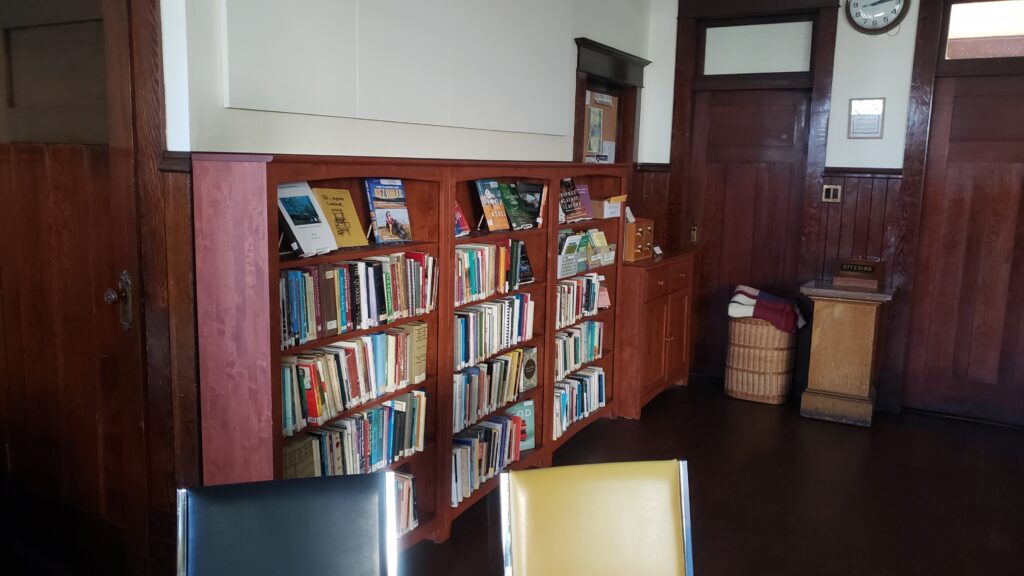
Maintain the Meeting library of books, magazines, and electronic resources (in Victoria) that are available to members/ attenders from any worshipping group.
Marriage Registrars:
(2 people) Who have to be registered with the Provincial Government. Administer legal, reporting, and recording requirements for Quaker marriages under the care of the Meeting. Currently shared with Cowichan Valley Quakers.
Ministry & Counsel (M&C):
(4 or 5) Nurtures the spiritual life of the Meeting and focuses the attention of the Meeting on needs of individual members and our community as a whole; oversees weddings, requests for membership and memorial meetings, as well as Pastoral Care, Children’s Committee and welcoming newcomers.
Nominating:
(2 or 3 people nominated by a Naming committee as vacancies arise at the end of individual terms) Develops and presents a list of nominations for consideration by the Monthly Meeting. The committee recommends candidates who can best serve according to their talents, interests, and the Meeting’s needs. Volunteers are encouraged to inform Nominating regarding their special interest for service. May also bring forward names for Canadian Yearly Meeting service.
Personnel:
(1 person at large, plus 1 person named by M&C and 1 by Property committee). Supports and supervises the service of the Meetinghouse Residents, including selection and periodic review.
Property:
(2 or 3 Victoria Friends, plus the Resident Friend). Responsible for the maintenance of the Meetinghouse and grounds, and providing guidelines for the use of the Meetinghouse by outside groups. Encourages engagement of all Friends in this work.
Records:
(1 or 2 Friends). Responsible to keep our archival records in good order; submits records to CYM or Provincial archives; maintains the registry (book) of members, marriages, births, deaths; recommends and implements policies for retention of records and schedules.
Representative to Canadian Yearly Meeting (CYM)
(1 plus alternate) Serves as a member of Representative Meeting, the body which acts for CYM between Yearly Meeting sessions.
Resident Friend(s):
Lives on site, responds to phone enquiries; opens, closes and cleans the Meetinghouse; supervises use of the Meetinghouse by Friends and other groups; and much more! Please respect their privacy and use the Meetinghouse phone number for Meeting business. Please contact Property Committee with concerns.
Trustees:
(3-4 people, appointed for a five year term). Named as holding the assets of the Meeting, and the Meetinghouse property is registered in their names. Financial responsibility is ultimately in their trust, as are insurance, property taxes and the Dorothy Webster Trust (for education). They submit an annual report to Meeting for Business and ensure a periodic financial review is undertaken.
Webminder:
(1 or more people). Maintains the Meeting website and supervises use of the Meeting’s Zoom account. Under general guidance and support from Ministry & Counsel and Communications Committee.
Other Roles in Victoria Friends Meeting
hands holding shoulders in a circle
These positions are created by the Victoria community and change from time to time.
Appointments are made on the recommendation of the Nominating Committee and are typically confirmed in June and commence their work in September.
Those below are listed alphabetically by position or committee.
Childcare:
( 5 or more people). Make suitable childcare arrangements for First Day school.
Closers:
( 1 or 2 people) Coordinate provision of ‘in person’ Meeting closers.
Education and Outreach:
(2 or 3 people) Arranges regular and occasional development activities for Friends and visitors, in close coordination with Program Committee.
Ecology Group:
(As led) Has an action-oriented focus on ecology.
Greeters:
(1 person) Coordinate provision of greeters before the ‘in person’ Meeting.
Hospitality:
(2 or 3 people) Ensure provision of snacks after Meeting, and cleanup. Note: This is a facilitation role.
Memorials:
(1 person) Memorials for all Friends and a yearly All Souls Memorial.
Music:
(2 people) Facilitates singing of hymns & songs (before Meeting once a month and at Christmas).
Peace Earth and Social Action Committee (PESAC):
(open to all members/ attenders) Addresses various issues of political/social concern, as identified by the Meeting or PESAC individuals. Supports, and recommends VIMM donations to, non-Quaker ventures that are consistent with Friends’ concerns.
Program Committee:
(2 or 3 people) Responsible for planning regular or periodic community activities and special events or workshops. Etc… Coordinates with Education and Outreach.
Youth:
(Several Friends recommended by Nominations committee). Contact for young friends. Facilitates programming, such as workshops, hikes, parties.
Zoom/Tech hosts:
(4-6 people) Open and close the Zoom space, provide spiritual ‘holding of the space’, welcome participants before Meeting for Worship and lead announcements at the end.