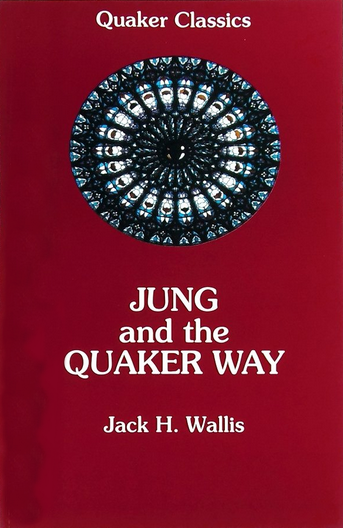
If you’re familiar with Quaker practice, but not with the psychological principles of Carl Jung, this book is a good introduction to Jung, as well as being an interesting perspective on the intersection of his principles with Quakerism. Jung, like Quakers, believed “that any true religion should be founded on experience, not on dogma, doctrine or a dutiful faith.” Jung had little interest in theology, but an intense interest in religion. He maintained, as Wallis says, that it is “the province of religion and psychology to work together in helping individuals towards integration, balance, and wholeness.” Wallis, via Jung, focuses on the needs and experiences of the individual — Jung, like George Fox, maintained that “we cannot understand a thing until we have experienced it inwardly,” as well as on the needs of the group, pointing out that the spiritual viability of a group, such as Quaker meeting for worship, depends on the self-awareness of each individual. This requires, among other things, the individual’s awareness of their Shadow, which Jung describes as “the negative side of the personality, the sum of all those unpleasant qualities we like to hide.”
Referring to group dynamics, Wallis, citing John MacMurray, a Quaker academic and moral philosopher, explains the difference between Functional relations that exist for a practical purpose, such as in a workplace, and Personal relations, which are “independent of any particular function. The intersection of the Functional and the Personal is important, in that “responsibility rests ultimately not on dogma or rules but on feelings, on goodwill, and on response to the needs and sufferings of others and a sense of their intrinsic value as individuals.” That being said, Wallis suggests a third kind of relationship — the spiritual, which involves a numinous quality.
Quakers often refer to the inward leading, or inward light; Jung talks of this in terms of a personal vocation, suggesting that one who listens to the inward voice is “called.” He believed that to become a personality, to be “individuated,” it was crucial to assent consciously “to the power of the inner voice […] That is the great and liberating thing about any genuine personality: he [sic] voluntarily sacrifices himself to his vocation.” Jung warns us, though, about the need to be aware of our various personae, which are the roles we adopt in order to fit in with conventional norms; he warns that we must not surrender our true selves to these roles. “The persona,” says Jung, “is that which in reality we are not, but which in our own and other people’s opinion, we are.”
In terms of the development of the individual, Jung believes “that the true goal of human development is not perfection (in the religious, moral, or spiritual sense), but wholeness.” Wallis points out that wholeness as a goal “is valid at all stages of life, a child should be a child, an adult should be an adult, an old person should be an old person and not an imitation young one. Each of us should seek the personal wholeness that is our own unique identity of mind, body, psyche, and soul.” It is this personal wholeness upon which a meeting for worship depends for its communal wholeness.
Balance and stability, both in the individual and in the group, depend, according to Jung, on the tension of opposites: opposing points of view, opposing needs or desire in the individual as well as in the group, opposing goals. “Every good meeting,” says Wallis, “has within it some spontaneous tension arising from the awareness of opposites. It is a tension of growth and insight, not of antagonism, competition, or rivalry.”
Wallis addresses images of God and of Jesus, referring primarily to Janet Scott’s 1980 Swarthmore lecture entitled What Canst Thou Say? Scott says that “what we say [about God] is provisional, symbolic, and metaphorical. So that when we speak of God in a personal way we do not mean that God is a person, only that personal language is the best way we have to express an inexpressible relation.”
If you have time to read only one chapter of the book, I suggest the last one, “A Reasonable Faith.” Though Wallis does not reference it, this was the title of a book published anonymously in 1884. The anonymous authors, originally cited as “Three Friends,” were later revealed to be three Quakers: William Pollard, Francis Frith, and William Z. Turner. This final chapter of the book is a well-articulated summary of the intersection of Jung’s principles of psychology with Quakerism. As Wallis writes, “Much of what [Jung] wrote is in harmony with the Quaker way, for instance his belief that religion should be founded on experience, at first hand rather than on dogma or doctrine; that no one can tolerate a life devoid of meaning; that the spiritual part of us is as real as the physical, the emotional, and the intellectual; that our inner life is as important as our outer experience; that a working harmony of differences and opposites is a mature achievement and a sign of psychological health; that an inner voice prompts us and an inner light guides us towards our personal vocation; that God is present in all human nature as well as transcendent; that faith and practice are two expressions of the same reality — our human responsibility.”