• The Hicksite Separation: A Sociological Analysis of

    Religious Schism in Early Nineteenth Century America

    By Robert W. Doherty (289.6 DOH)

                This book traces the sociological or societal, as well as the religious, issues, particularly in the Philadelphia area of 19th century America, that led to the so-called Hicksite Separation (named after Elias Hicks) of 1827.  Doherty points out that the early 19th century Quakers in and around Philadelphia headed towards this separation because they “lacked any institutional means for resolving conflict.” There were problems with methods of appointment and with jurisdiction, and with the fact that all decisions were supposed to be unanimous.  As for their beliefs, difficulty arose because of the conflict between their commitment to the ideals of peace, equality, and simplicity, and the participation in the affairs of the world—how could Quakers focus on the Inner Light at the same time as taking part in the external affairs of the world? Another source of conflict within the Society was how to deal with slavery.  Hicks and his supporters condemned all aspects of slavery, while what would come to be called the Orthodox supporters were not so unqualified in their judgment. By 1827, the “official” Hicksite-Orthodox Separation, the questions that confronted the Society of Friends were: “who should be a member of the Society, how should the Society be organized, how does a Friend seek salvation, and to what extent should a Friend accept the ways of the world?” “The Orthodox wanted to make their peace with the secular world,” while the Hicksites were more drawn to quietism.

                One of the principal divisions in approach for the Orthodox and the Hicksites was that of sect and church.  The Hicksites were more sectarian, meaning that they favoured withdrawal from the world and from the formal structure of the conventional Christian churches; the Orthodox were more drawn to those formal structures and doctrines.  The Orthodox tended to be wealthier and engaged in high prestige occupations, most of them living in the city; the Hicksites, on the other hand, were more deliberately alienated from any focus on wealth and status, and were more rural.  Doherty lists the following sources of such alienation: “1) suspicion of the city; 2) commitment to social values which were threatened by Orthodoxy; 3) resentment of Orthodox social climbing; 4) psychological shock resulting from worldly failure; 5) commitment to egalitarianism and/or religious freedom, both of which were felt to be challenged by Orthodoxy.”

                Even though agriculture was a focus of both the Orthodox and the Hicksites, “Orthodox Quakers were more likely to be engaged in commercial agriculture.” Elias Hicks appealed to those outside the city, using rural images in his sermons; “he appealed to rural people as one of their own—a devout and kindly tiller of the soil.” “The appeal of Orthodoxy outside the city of Philadelphia,” on the other hand, “seems […] to have been greatest among those Friends who had ties with the outer world. “Such ties might be occupational (commercial farming), residential (living in West Chester or Chester), or institutional (Westtown School).”

                Orthodoxy “was in the air” of early 19th century America, but was especially influenced, for American Quakers, by the Orthodox sentiment in English Quakerism.  The very fact of the Hicksites’ focus on quietism as opposed to engaging with the secular world at large, was also a factor in the formal organization of Orthodox Quaker churches.  The Hicksites were conservatives when it came to preserving the traditions of simplicity and equality from the days of George Fox, but liberal when it came to understanding and interpreting doctrine and the scriptures — also deriving from the days of George Fox. “Liberals felt that all men had the right to believe and worship as they wished.  All men should be guaranteed an opportunity to seek religious truth for themselves.  In the mind of the liberals, Elias Hicks had a right to believe and say whatever his spirit led him to believe and say.” The Hicksites focused on behaviour; the Orthodox on belief.

                To understand the background and consequences of the Hicksite Separation is to understand the divide between programmed and unprogrammed meetings, and to see how our Vancouver Island Monthly Meeting can trace its roots as an unprogrammed Meeting back to Elias Hicks and his supporters.   
  • Rufus Jones. Essential Writings

    Selected with and Introduction by Kerry Walters (289.6 JON)

              At his birth in Maine in 1863, Rufus Jones’s Aunt Peace said of him, “This child will one day bear the message of the Gospel to distant lands and to peoples across the sea.” And so, he did.  By the time he was four years old, he said that he “had formed the habit of using corporate silence in a heightening and effective way.” In his undergraduate years at Haverford College, he studied religion, philosophy, and history, and wrote his senior thesis on mysticism.  In 1917, he was one of the founding members of the American Friends Service Committee, a relief organization that embodied the Quaker tenet of non-violence in times of war.  For Jones, “the whole significance of the Quaker movement was its revolt from theories and notions and its appeal instead to experience.” Jones considered himself, and was considered by others, a mystic; he referred to himself as a “practical” or “conative” mystic, in the Christian tradition — “the original mystical experience feels like a thrust from beyond.” Indeed, his personal experience, along with scriptural authority, convinced him the of the reality and presence of the inner Light, which he called “the Beyond within” or “the More,” which allowed for a “mutual and reciprocal correspondence” between God and humans.  And so, he talked often of “this Over-world of Beauty, Goodness, Truth, and Love,” a world beyond the material one we are bound up in.

              Jones writes of Gandhi’s “soul-force” and the Indian mystical tradition, including the Upanishads, and the well-known “That are thou,” which refers to the identification of “the inmost being of [one’s] own self with the inmost Reality in the universe.” He writes also, in this regard, of Emerson’s Over-soul.  The soul, for Jones, “accumulates and interprets facts and processes of experience, not experience as it is felt.” Still, the essential fact of religion for Jones is “love, and life is impossible apart from relationships.” Furthermore, we must not expect to find God apart from spiritual relationships. Somewhat like the Hindu concept of Brahman and Atman, the Self and the self, Jones says that our relationship with God is our limited self with God’s infinite Self.  God is both transcendent and immanent.  And this is where Jones’s understanding of worship comes in: “worship seems to me to be direct, vital, joyous, personal experience and practice of the presence of God (italics his).” “We cannot explain our normal selves,” Jones continues, “or account for the best things we know—or even for our condemnation of our poorer, lower self — without an appeal to and acknowledgment of a Divine Guest and Companion who is the real presence of our central being.” Indeed, the Quakers in the 17th century, as Jones reminds us, were the first organized body of Christians to build a faith on the principle that “something of God is in every man.”

              But how to understand the concept of God? Quakers believed, and believe, that “God is essentially Spirit.  He is Life and Thought and Love and Goodness in unceasing revelation and action.” And all this is a fact of experience — “something seen and felt and known” — not simply something derived from traditional authority.  We do not, then, need “to go ‘somewhere’ to find God.  We only need to be something.”

              For Jones, everyone is a potential mystic.  He argues that, as children, we all had the capacity for surprise and wonder, referring to Wordsworth’s “Ode: Intimations of Immortality from Recollections of Early Childhood.” “To see the eternal in the midst of time,” writes Jones, “to feel and to enjoy the infinite here in the finite, is one of the greatest blessings life has to offer.” The mystical experience means that the human spirit and the divine spirit have met and “are in mutual and reciprocal correspondence.” Therefore, “both life and religion are rooted in mystical experience, mystical process,” and Christianity is, for him, “at its very heart a mystical religion.” That being said, Jones distinguishes between “negation mysticism” and “affirmation mysticism,” the former making vision the end of life, the latter making it the beginning.

    Imagination is a crucial ingredient here — “Getting your imagination captured is almost the whole of life. […] The way to become the architect of your fate, the captain of your soul, is to have your imagination captured.” All this talk of the individual, however, should not blind us to the fact that the primary fact of human life is the group that makes the individual possible.  It is an organic way of life, “where each lives for all and where the interpretation of the Life of the Whole is the business and at the same time the joy of each unit-member.” The corollary to this is that “the kingdom of God is something men [sic] do—not a place to which they go.” This also means that this kingdom is here and now, not in some realm of the afterlife.

    Talking of prayer, Jones writes that it must “rise above [its conception] as an easy means to a desired end.” The point of prayer is to turn to God “as the completeness and reality of all we want to be, the other Self whom we have always sought.” This means, also, that we must want only what everybody can share, that we must seek blessings which have a universal application.

    Jones also addresses one of the primary Quaker testimonies, that of simplicity, relating it to sincerity, genuineness, and being honest with oneself.

    He goes on to distinguish between unity and uniformity, pointing out that uniformity, depending on a mechanistic rather than a spiritual organization “levels down instead of up.” Unity, on the other hand, has to do with a growing organism.

    Finally, Jones points out that Quakers have been primarily doers—“they believe strongly in the laboratory method.  They try their experiment and then proceed to interpret it.  The words, the talk, come after the deeds.”

  • A Librarian Muses about Libraries

    If, as a librarian, I allow myself some time to muse about libraries, it is only fitting that I begin with reference to the great Library at Alexandria in Egypt, which is believed to have been instituted by Ptolemy II, pharaoh and basileus of the Ptolemaic Kingdom, sometime in the 3rd century BCE.  It formed part of the Mouseion, a place dedicated to the Muses.  At its height, it is said to have contained up to 400,000 papyrus scrolls.

              At their best, libraries, of whatever size and grandeur, are repositories of the human endeavour to know about our world, about ourselves, and to imagine and speculate about what we do not know.  Arnold Ranneris, without whom our Meeting House Library would not exist as it does, felt that the purpose of a library was best expressed by words he had seen on a poster: “The Spirit of God may emerge from the pages of a book to take wings in the life of a reader.” In a passage that appears in Faith and Practice of Canadian Yearly Meeting of the Religious Society of Friends, he writes, “Since our unprogrammed meetings do not have teaching sermons, a heavy responsibility lies with each person to learn on her own; faith is a maturing process that must go on all of one’s life.  Reading thoughtfully somehow sensitizes a person and broadens and sharpens his perception and awareness.  Good books seem to hold a mirror up to us, and we see ourselves in reflection in a different light.”

              The books in a library form an odd kind of community, for though the books stand shoulder to shoulder and shelf upon shelf, they are their own, individual selves, as are we, who wander amongst them looking for a special one-on-one contact.  We choose one or two or three and take them home to visit for a few weeks, giving each one its own special time with us.  For those minutes or hours we sit and read a book, we step outside of one world to enter another; we step outside our “normal” time and space to experience someone else’s.  “Camerado,” writes Walt Whitman in his poem “So Long” from Leaves of Grass, “this is no book, / Who touches this touches a man.” And John Milton, in his Areopagitica: “A good book is the precious life-blood of a master-spirit, embalmed and treasured up on purpose to a life beyond life.”

    I’m sure you’ve had the experience of being deeply engrossed in a book, when your roommate or some other human calls you or taps you on the shoulder and you feel that jarring moment of disorientation when you’re caught between two worlds, not quite sure how to make the transition from the one in the book, where you’ve been, to the one where your roommate is standing, the one you had temporarily left behind.

    As libraries go, our Meeting House Library is, perhaps, a minor affair.  But it is our affair.  It offers us spiritual direction and nourishment, challenge and stimulation, respite and comfort, if we would but take the hand it reaches out to us.

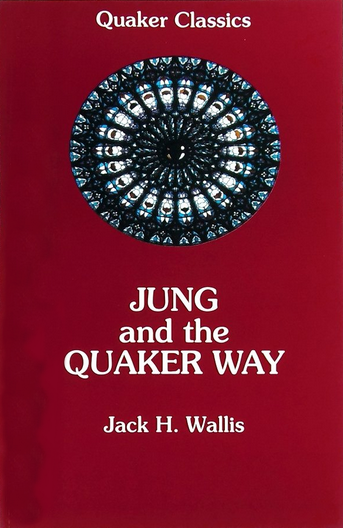
  • Jung and the Quaker Way by Jack H. Wallis (289.6092 WAL)

              If you’re familiar with Quaker practice, but not with the psychological principles of Carl Jung, this book is a good introduction to Jung, as well as being an interesting perspective on the intersection of his principles with Quakerism.  Jung, like Quakers, believed “that any true religion should be founded on experience, not on dogma, doctrine or a dutiful faith.” Jung had little interest in theology, but an intense interest in religion.  He maintained, as Wallis says, that it is “the province of religion and psychology to work together in helping individuals towards integration, balance, and wholeness.” Wallis, via Jung, focuses on the needs and experiences of the individual — Jung, like George Fox, maintained that “we cannot understand a thing until we have experienced it inwardly,” as well as on the needs of the group, pointing out that the spiritual viability of a group, such as Quaker meeting for worship, depends on the self-awareness of each individual.  This requires, among other things, the individual’s awareness of their Shadow, which Jung describes as “the negative side of the personality, the sum of all those unpleasant qualities we like to hide.”

              Referring to group dynamics, Wallis, citing John MacMurray, a Quaker academic and moral philosopher, explains the difference between Functional relations that exist for a practical purpose, such as in a workplace, and Personal relations, which are “independent of any particular function.  The intersection of the Functional and the Personal is important, in that “responsibility rests ultimately not on dogma or rules but on feelings, on goodwill, and on response to the needs and sufferings of others and a sense of their intrinsic value as individuals.” That being said, Wallis suggests a third kind of relationship — the spiritual, which involves a numinous quality.

              Quakers often refer to the inward leading, or inward light; Jung talks of this in terms of a personal vocation, suggesting that one who listens to the inward voice is “called.” He believed that to become a personality, to be “individuated,” it was crucial to assent consciously “to the power of the inner voice […] That is the great and liberating thing about any genuine personality: he [sic] voluntarily sacrifices himself to his vocation.” Jung warns us, though, about the need to be aware of our various personae, which are the roles we adopt in order to fit in with conventional norms; he warns that we must not surrender our true selves to these roles.  “The persona,” says Jung, “is that which in reality we are not, but which in our own and other people’s opinion, we are.”

              In terms of the development of the individual, Jung believes “that the true goal of human development is not perfection (in the religious, moral, or spiritual sense), but wholeness.” Wallis points out that wholeness as a goal “is valid at all stages of life, a child should be a child, an adult should be an adult, an old person should be an old person and not an imitation young one.  Each of us should seek the personal wholeness that is our own unique identity of mind, body, psyche, and soul.” It is this personal wholeness upon which a meeting for worship depends for its communal wholeness.

              Balance and stability, both in the individual and in the group, depend, according to Jung, on the tension of opposites: opposing points of view, opposing needs or desire in the individual as well as in the group, opposing goals.  “Every good meeting,” says Wallis, “has within it some spontaneous tension arising from the awareness of opposites.  It is a tension of growth and insight, not of antagonism, competition, or rivalry.”

              Wallis addresses images of God and of Jesus, referring primarily to Janet Scott’s 1980 Swarthmore lecture entitled What Canst Thou Say? Scott says that “what we say [about God] is provisional, symbolic, and metaphorical.  So that when we speak of God in a personal way we do not mean that God is a person, only that personal language is the best way we have to express an inexpressible relation.”

              If you have time to read only one chapter of the book, I suggest the last one, “A Reasonable Faith.” Though Wallis does not reference it, this was the title of a book published anonymously in 1884.  The anonymous authors, originally cited as “Three Friends,” were later revealed to be three Quakers: William Pollard, Francis Frith, and William Z. Turner.  This final chapter of the book is a well-articulated summary of the intersection of Jung’s principles of psychology with Quakerism.  As Wallis writes, “Much of what [Jung] wrote is in harmony with the Quaker way, for instance his belief that religion should be founded on experience, at first hand rather than on dogma or doctrine; that no one can tolerate a life devoid of meaning; that the spiritual part of us is as real as the physical, the emotional, and the intellectual; that our inner life is as important as our outer experience; that a working harmony of differences and opposites is a mature achievement and a sign of psychological health; that an inner voice prompts us and an inner light guides us towards our personal vocation; that God is present in all human nature as well as transcendent; that faith and practice are two expressions of the same reality — our human responsibility.”

  • On Tyranny: Twenty Lessons from the Twentieth Century By Timothy Snyder (321.9 SNY)

    Reviewed by Matthew Manera.

    Though this book was published in 2017 and deals with the aftermath of Trump’s election in 2016, it applies just as well, perhaps even more so, to where we are in 2025. Snyder begins with a Prologue on History and Tyranny to set the stage for the rest of the book.

    The second of these twenty lessons is “Defend Institutions,” in which he writes, “The mistake is to assume that rulers who came to power through institutions cannot change or destroy those very institutions—even when that is exactly what they have announced that they will do.”

    In the chapter “Beware the one-party state,” he quotes the American abolitionist Wendell Phillips, who said that “eternal vigilance is the price of liberty,” adding that “the manna of popular liberty must be gathered each day or it is rotten.” This is a reference to Exodus 16:4 ff—check it out. With regard to safeguarding the electoral system, Snyder says, “We need paper ballots, because they cannot be tampered with remotely and can always be recounted.”

    Concerning professional ethics, he writes, “Professional ethics must guide us precisely when we are told that the [political] situation is exceptional.  Then there is no such thing as ‘just following orders.’ If members of the professions [especially politicians and lawyers] confuse their specific ethics with the emotions of the moment […] they can find themselves saying and doing things that they might previously have thought unimaginable.”

    In another chapter, “Stand Out,” he says, “Someone has to.  It is easy to follow along.  It can feel strange to do or say something different.  But without that unease, there is no freedom.  Remember Rosa Parks. The moment you set an example, the spell of the status quo is broken, and others will follow.”

    “Be kind to our language” advises us to “avoid pronouncing the phrases everyone else does.  Think up your own way of speaking, even if only to convey that thing you think everyone is saying.  Make an effort to separate yourself from the internet.  Read books.” “Politicians in our times,” he continues, “feed their clichés to television, where even those who wish to disagree repeat them. […] Everything happens fast, but nothing actually happens.  Each story on televised news is ‘breaking’ until it is displaced by the next one.  So we are hit by wave upon wave but never see the ocean.” He also refers to the suppression of books and the narrowing of vocabularies, and “the associated difficulties of thought.” Snyder advises us to “get the screens out of your room and surround yourself with books.”

    “Believe in truth,” he writes.  “To abandon facts is to abandon freedom.  If nothing is true, then no one can criticize power, because there is no basis upon which to do so.  If nothing is true, then all is spectacle.  The biggest wallet pays for the most blinding lights.” “You submit to tyranny when you renounce the difference between what you want to hear and what is actually the case.”

    In the chapter “Investigate,” Snyder encourages us to “figure things out for yourself” and to “take responsibility for what you communicate with others.” “It is your ability to discern facts that makes you an individual, and our collective trust in common knowledge that makes us a society. The individual who investigates is also the citizen who builds.  The leader who dislikes the investigators is a potential tyrant.”

    Snyder argues that we must “Practice corporeal politics—power wants your body softening in your chair and your emotions dissipating on the screen.  Get outside.  Put your body in unfamiliar places with unfamiliar people.  Make new friends and march with them.”

    These are only a few of the lessons about which Snyder writes.  The book is easy to read—only 125 pages in a 4-inch by 6-inch edition.

  • Review: Friends for 300 Years by Howard H. Brinton (289.6 BRI)

    Reviewed by Matthew Manera.

    Brinton’s overview of Quakerism, unlike Elfrida Vipont’s The Story of Quakerism 1652-1952 and Ben Pink Dandelion’s An Introduction to Quakerism, “is not”, as Brinton says in his Introduction, “to produce a history of Quakerism, but, by means of historical illustrations, to examine a method.” In this way, it is a useful complement to these two books. Brinton examines early Quakerism by focusing on George Fox’s pastoral Epistles and Robert Barclay’s Apology, the former portraying “Quakerism as felt,” or experienced; the latter portraying “Quakerism as thought about.”

    I’m trusting that those of you who read this are familiar with the basic historical facts of early Quakerism, and so will move quickly over the first three chapters, “To Wait Upon the Lord,” “The Light Within as Experienced,” and “The Light Within as Thought About.” Brinton explains how Quakers sought a religion based on the Spirit within, rather than on externally imposed forms and disciplines, how the Light Within or Spirit “was primary and the Scriptures a word of God” which is secondary and serves to “[confirm] and [clarify] the revelations of the Light Within”; he quotes Margaret Fell quoting George Fox —”You will say, Christ saith this, and the apostles say this; but what canst thou say?”; and mentions how the Light was to be realized in experience rather than in theory by “answering.” As Fox wrote, “Be faithful and spread the Truth abroad and walk in the Wisdom of God answering that of God in every one.” Brinton also distinguishes how Fox, as prophet, followed the Hebrew tradition, “bearing witness to the personal God whose prophets are instruments through which He utters his voice and works his will,” and how he, as philosopher, “followed the Hellenic tradition, apprehending the inner Unity which exists beyond time and space, Real as compared with the phenomenal world, One, as contrasted with the multiplicity recognized by the senses.”

    Brinton also distinguishes between the Eternal Christ and the Historic Jesus, the former being the Light Within that is a part of every person, so that, as Fox writes, “we are regenerated, not so much by the death of Christ [the Historic Jesus], as by his life in our hearts.” He addresses the idea of Perfectionism, which Barclay was careful to explain: “Perfection means simply living up to the measure of light that is given [to each of us], and if we are faithful to that, we shall be given more.” Brinton concludes the first three chapters with this: “In Quakerism there are two complementary movements, withdrawal to an inward Source of Truth and return to action in the world.  The first is Greek in its religious emphasis, the second, Hebrew.  Quakerism is both contemplative and active, both metaphysical and ethical, not because it has combined the two in a consistent system of thought, but because it has combined them through experience.”

    In discussing the Meeting for Worship, Brinton observes, “As Catholic worship is centered in the altar and Protestant worship in the sermon, worship for the Society of Friends attempts to realize as its center the divine Presence revealed within,” which involves the idea of withdrawal and return mentioned above: “In worship we center our attention on that which is deeper than discursive thought.” Meetings for Worship involve a measure of vocal ministry, and what Brinton has to say about this should speak to us today: “Ministry in a Friends meeting should be spontaneous in the sense that no one comes to meeting either expecting to speak or expecting not to speak.” “The first-person singular pronoun is seldom heard in Quaker ministry, nor does the speaker declare his own experience except as his experience may illustrate a more general truth.” The speaker should “learn to recognize and reject the wish to speak which comes from a different source [than the Spirit], however disguised, such as an inclination to exhibit his own powers or knowledge or simply lack of inhibition.”

    Writing of how Quakers reach decisions, Brinton says, “the meeting is to act as a whole and be governed by Truth, not by persons appointed to rule.” Distinguishing meeting for worship from meeting for business, he says, “the meeting for worship concerns being, while the meeting for business concerns doing.” Meetings for business, in making decisions for moving forward on any issue, depend on all voices being heard and on consensus, rather than on compromise: “At its best, the Quaker method does not result in compromise [which] is not likely to satisfy anyone completely.  The objective of the Quaker method is to discover Truth which will satisfy everyone more fully than did any position previously held.” Neither is unity to be equated with uniformity: “Unity is spiritual, uniformity mechanical.” Ideally, anyone who speaks in meeting for business will begin with “I feel,” rather than “I think,” feeling being the “intuitive apprehension of the Light of Truth.” That being said, he points out that the Quaker method works better in small rather than large groups, and that it “is likely to be successful in proportion as the members are acquainted with one another; better still if real affection exists among them.” As for the origin of social concerns in Quakerism, Brinton says that the focus in this area has to do with Community, Harmony, Equality, and Simplicity.

    In terms of the intersection of the Meeting and the World, Brinton describes Quaker work among Negro slaves and Indians [designations Brinton uses throughout his book], as well as the non-violent approaches they took towards those in prisons, beginning with the work of Elizabeth Fry in England in 1813, and towards those in mental hospitals, where the first such hospital in the United States to work with Quaker principles, the Pennsylvania Hospital in Philadelphia, founded in 1756, “was the first institution where cure rather than custody and repression was the underlying principle in the treatment of the insane.”

    As for the reason for the Quaker peace testimony, Brinton says of soldiers that “the soldier who is killed suffers a material injury; the soldier who kills suffers a spiritual injury.” Relief work, “undertaken to repair damages caused by war or conflict is a natural corollary of the peace principle.  Its beginnings go back to the Irish war in 1690, and the banishment of Acadians from Canada in 1755, and continue through to the establishment of the American Friends Service Committee in 1917 during the first World War.  A follow-up to Brinton’s book, Friends for 350 Years (289.6 BRI), was published in 2002, with a historical update and notes by Margaret Hope Bacon, tracing the developments in Quakerism, especially in America, between 1952 and 2002.

  • Review of A Door into Ocean by Joan Slonczewski (Fic SLO)

    Reviewed by Alex Roberts

    Review of A Door into Ocean by Joan Slonczewski (Fic SLO)

    Ever heard of Quaker science fiction?  In 1986, Joan Slonczewski published a novel set on the distant aquatic planet of Shora, whose inhabitants resist an extractive military-colonial force with the power of nonviolent resistance.  Some parts of it will feel familiar to Friends, and not just because the amphibious people of Shora, called “Sharers,” seem to be organized around a seafaring system of Monthly Meetings! 

    The story begins with a young man, a citizen of the colonial empire, who is brought to Shora by two Sharers who want to see if an outsider can learn their ways and live among them.  He does, slowly, adapt to a culture built on simplicity, peace, integrity, community, and stewardship, and finds ways to help defend and support the Sharers from their invaders.  Don’t expect a “messianic” trope here, however.  His role in the Sharer’s resistance is relatively minor, as the narrative shifts more and more to the Sharers and their internal conflict and struggle to maintain their egalitarian society and ecological balance in the face of overwhelming power. 

    The author, also a microbiologist, blends a painfully detailed description of ecological destruction with imaginative speculative biology.  For example, I loved her description of Sharers developing a morse code-like messaging system via a symbiotic species of insect!  It’s a memorable book, and not just because of its ecofeminist, anti-war, anti-colonial, and scientific themes.  I would recommend A Door into Ocean to anyone who enjoys well-written novels with unique ideas and deep characterization. 

    I hope to make Slonczewski’s other, more explicitly Quaker, sci-fi novel Still Forms on Foxfield the subject of a future review.

    [It is the first book in the Elysium series — see Wikipedia entry]

  • Book Review: This is Real and You Are Completely Unprepared…

    Matthew Manera’s Review of This is Real and You Are Completely Unprepared. The Days of Awe as a Journey of Transformation by Rabbi Alan Lew (296.43 LEW)

    Book Review: This is Real and You Are Completely Unprepared…

    At first glance, this is a book about the Jewish High Holidays, and, of course, it is.  But though it addresses the specific holidays, from Tisha B’Av [the day of mourning for the destruction of the Temple in Jerusalem] to Sukkot [the autumnal harvest festival], it speaks to anyone who is concerned with spiritual transformation.

    All significant religious texts will overlap in some degree when it comes to the most substantial understanding of what the relationship between the human and the divine, or between a disciple and a teacher, is (Rabbi Alan Lew, before becoming a Rabbi, spent ten years as a committed practitioner of Zen Buddhist meditation).  For example, in the Bhagavad Gita, Krishna says to Arjuna, “No matter by what path men approach Me [you can read “Me” to be your own understanding of God], they are made welcome.  For all paths no matter how diverse lead straight to Me. All paths are mine, notwithstanding by what names they may be called.” And when the Buddha was addressing the inhabitants of the small town of Kesaputta, he said, “Now, look you Kalamas, do not be led by reports of religious texts, nor by mere logic or inference, nor by considering appearances, nor by the delight in speculative opinions, nor by seeming possibilities, nor by the idea: ‘this is our teacher.’ But, O Kalamas, when you know by yourselves that certain things are unwholesome and wrong and bad, then give them up […] And when you know for yourselves that certain things are wholesome and good, then accept them and follow them.” This reminds me of two passages from George Fox’s Journals: he said about his faith, “And this I knew experimentally,” and about the teachings of Christ, “You will say, Christ saith this, and the apostles say this; but what canst thou say?”

    Here are some passages (some quoted directly; some paraphrased) from the book that might entice you into engaging in a dialogue with it:

    • Spiritual practice will not change what happens to us; rather, it will change us.

    • [with reference to being called to account for our actions, feeling that we are ready and confident to do so, but finding that we are, unexpectedly, completely unprepared] “And [this sense of being completely unprepared] is real whether you believe in God or not. Perhaps God made it real and perhaps God did not.  Perhaps God created this pageant of judgment and choice, of transformation, of life and death.  Perhaps God created the Book of Life and the Book of Death, Teshuvah and the blowing of the shofar.  Or perhaps these are all just inventions of human culture. It makes no difference.  It is equally real in any case.”

    • “Perhaps God made the reality that all this human culture seeks to articulate.  Perhaps God made a profoundly mixed world, a world in which every second confronts us with a choice between blessings and curses, life and death; a world in which our choices have indelible consequences; a world in which life and death, blessings and curses, choose us, seek us, find us every moment.  And we live with the consequences of our choices.  And perhaps we have chosen arbitrary spiritual language to express these things, or perhaps God made human culture so that we would express these things precisely as we have in every detail.  It makes no difference.  What makes a difference is that it’s real and it is happening right now and it is happening to us, and it is utterly inescapable, and we are completely unprepared.  This moment is before us with its choices, and the consequences of our past choices are before us, as is the possibility of our transformation.”

    • “The first thing we do during the High Holidays is come together; we stand together before God as a single spiritual unit. […] We heal one another by being together.  We give each other hope.”

    • “Most of us only embark on the difficult and wrenching path of transformation when we feel we have no choice but to do so, when we feel as if our backs are to the wall, when the circumstances of our lives have pushed us to the point of a significant leave-taking, when we have suffered loss or death, divorce or unemployment.  Transformation is just too hard for us to volunteer for. […] We are in the predicament that has brought us to the point of transformation because God has driven us there.  In other words, that predicament is part of the process.  It is a gift, the agent of our turning. […] Transformation is not something that happens once and for all time. […] Transformation does not have a beginning, a middle, or an end. […] And it may never be clear to us that the work of transformation has borne fruit […] Real spiritual transformation invariably takes a long time to manifest itself in our lives.”

    • [Lew quotes from Shunryu Suzuki, in his book Zen Mind, Beginner’s Mind] “If your mind is empty, it is always ready for anything; it is open to everything.  n the beginner’s mind there are many possibilities; in the expert’s mind there are few […] In the beginner’s mind there is no thought, ‘I have attained something.’ All self-centred thoughts limit our vast mind.  When we have no thoughts of achievement, no thought of self, we are true beginners.”

    • “Every spiritual tradition I am aware of speaks of a kind of layered mindfulness, a sensibility that works up and out of the body, to the heart and then to the mind and then finally to the soul.  The Buddhist sutra On Mindfulness describes this kind of layered grid of awareness, and the Kabala, the Jewish mystical tradition, speaks of it too.”

    • “None of us is whole by ourselves.  A spiritual community is one in which we find wholeness, completion with others.  What we lack is provided by somebody else.”

    • [on death] “We are born and we die, and nothing that happens in between is nearly as important as these two fundamental facts of life. […] Once life is over, it is clear that it has taken up no time or space at all. […] What lives on of the people we have loved and lost?  What breaks our hearts when we think of them?  What do we miss so much that it aches?  Precisely that suchness, that unspeakable, ineffable, intangible quality, which takes up no space at all and which never did.”

    • “What is the core of our life?  Are we living by it?  Are we moving toward it?  We shouldn’t wait until the moment of our death to seek the answers.  At the moment of death, there may be nothing we can do about it but feel regret.  But if we seek answers now, we can act in the coming year to bring ourselves closer to our core.”

    • “We can’t control sickness, old age, or death.  We are terrified of them.  But as Sharon Salzberg asks, what would we fear if we experienced ourselves to be part of the whole of nature, moving and changing, being born and dying?  What would we fear if we understood that our bodies were joined with the planet in a continual, rhythmic exchange of matter and energy?”

    • “Joy is a deep release of the soul, and it includes death and pain.  Joy is any feeling fully felt, any experience we give our whole being to.”

    • “Every moment of my life, I am inescapably hammered into place by everything that has ever happened since the creation of the universe, and every moment I am free to act in a way that will alter the course of that great flow of being forever.”

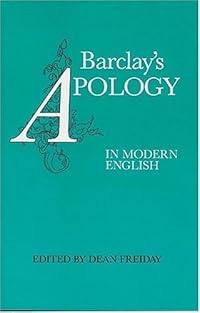
  • Book Review: Barclay’s Apology in Modern English

    Matthew Manera’s Review of “Barclay’s Apology in Modern English (289.6 BAR)” July 2025

    Book Review: Barclay’s Apology in Modern English

              “What I have written comes more from what I have heard with the ears of my soul. I have declared what my inward eyes have seen and what my hands have handled of the Word of Life. It is what has been inwardly manifested to me of the things of God.” So writes Robert Barclay at the beginning of his Apology, which consists of fifteen theological theses, or propositions, published in 1676 in Latin, then in English in 1678. It should be noted that this edition of the Apology is rendered into modern English by Dean Freiday and is an abridged and edited edition, which some scholars have criticized in parts for misrepresentation of Barclay’s ideas. Barclay makes many references to Christ, which, given the beginnings of Quakerism in the Christian tradition, is inescapable. However, for those Quakers who do not consider themselves bound by the Christian tradition, one can read “Christ” as “Spirit,” and still find these propositions speak to their condition.

               Proposition 1, “The True Foundation of Knowledge,” serves as an introduction to the following fourteen propositions: “Since the height of all happiness is the true knowledge of God, it is primary and essential that this foundation of knowledge be properly understood and believed.”

              In Proposition 2: “Inward and Unmediated Revelation,” Barclay insists that divine inward revelations and inward illuminations are “absolutely necessary for the building up of true faith” and “possess their own clarity and serve as their own evidence.”

              As for the Scriptures, which he addresses in Proposition 3, they are “only a declaration of the source, and not the source itself” and “are not to be considered the principal foundation of all truth and knowledge,” but only “as a secondary rule that is subordinate to the Spirit.”

              In Proposition 4, “The Condition of Man in the Fall,” Barclay argues against the Augustinian-based concept of original sin, writing that “we do not impute the evil seed to infants until they have actually been joined to it by their own transgression.”

              Freiday puts Propositions 5 and 6 (“The Universal Redemption by Christ, and also the Saving and Spiritual Light by which Every Man is Enlightened”) together in one chapter.  Proposition 5 refers to the Fall of Man (Proposition 4) by pointing out “the real light which enlightens every man,” which is Christ, and according to John 1:9, “is no less universal than the seed of sin, being purchased by his death who tasted death for everyone.” In Proposition 6, Barclay argues that “the universality of Christ’s saving death” is available to everyone in every time: “Just as many of the ancient philosophers may have been saved, so may some of those today whom providence has placed in remote parts of the world where the knowledge of history [i.e. the historical Jesus] is lacking, be made partakers of the divine mystery if they do not resist the manifestation of grace which is given to everyone for his benefit. […] The benefit of [Christ’s] suffering is extended not only to those who have a well-defined outward knowledge of his death and sufferings, […] but even to those who by some unavoidable accident were excluded from the benefit of this knowledge.”

              Proposition 7 deals with Justification, which Barclay defines as “the formation of Christ within us, from which good works follow as naturally as fruit from a fruitful tree.” We are justified, therefore, “not by works produced by our own wills, or by good works themselves, but by Christ, who is not only the gift and the giver, but the cause which produces these effects in us.”

              Perfection [or The Achievement of Spiritual Maturity] is the theme of Proposition 8.  Barclay makes clear that by Perfection, he means something “that is proportional to a man’s requirements.” When, in this state of relative perfection, one “is no longer able to obey any suggestions or temptations toward evil, but is freed from sin and the transgression of the law of God, and in that respect is perfect.”

              Proposition 9, “Perseverance in the Faith and the Possibility of Falling from Grace,” is the consequent counterpart to Proposition 8, in that “even though this gift of the inward grace of God is sufficient to bring about salvation, yet for those who resist it, it not only may become their condemnation, but does. […] Nevertheless, it is possible to achieve […] an increase and stability in the truth in this life that total apostasy is impossible.”

              Ministry, the subject of Proposition 10, presents Barclay’s, and Quakers’, understanding of how ministry should be understood: “Every evangelist and every Christian pastor ought to be led and directed in his labour in the work of the gospel by the leadings, motions, and drawings of God’s light.  These should govern not only the place where, but the persons to whom he speaks, and the time when he should speak. […] Those who have received this holy and unspotted gift [of ministering] have received it without cost and should give it without charge.” One should keep in mind that, at the time Barclay is writing, itinerant ministers, especially among Quakers, were common.

              In Proposition 11, “Worship,” Barclay writes of all those Quakers who are not called to be itinerant ministers, while hearkening back to the subject of Proposition 2: “True and acceptable worship of God stems from the inward and unmediated moving and drawing of his own Spirit. It is not limited by places, times, or persons. […] We should be moved by the secret stimulation and inspiration which the Spirit of God provides in our hearts.”

              Barclay addresses Baptism in Proposition 12, by citing Ephesians 4:5 and 1 Peter 3:21: “Just as there is ‘one Lord, and one faith,’ so is there ‘one baptism,’ which is ‘an appeal to God for a clear conscience, through the resurrection of Jesus Christ.’” He points out, as well, that “the baptism of infants, however, is [unlike the figurative baptism of John] a mere human tradition, for which neither precept nor practice is to be found anywhere in scripture.”

              Communion, another of the Christian sacraments, like Baptism, is the subject of Proposition 12: “The communion of the body and blood of Christ is inward and spiritual.  It is by participation in his flesh and blood that the inward man is nourished daily in the hearts of those in whom Christ dwells.”

              Proposition 14, “Concerning Civil Power [“the power of the Civil Magistrate” in the original] in Matters Purely Religious and Pertaining to the Conscience,” argues that one’s own conscience, derived from God, is to be regarded more highly than any civil power: “The power and dominion of the conscience are the province of God, and he alone can properly instruct and govern it.  No one whatsoever may lawfully force the consciences of others regardless of the authority or office he bears in the government of this world.” That being said, this is “always subject to the provision that no man, under pretense of conscience, may prejudice the life or property of his neighbour, or do anything that is destructive to human society or inconsistent with its welfare.”

              Lastly, Proposition 15 deals with “Vain and Empty Customs and Pursuits.” “The chief purpose of all religion,” writes Barclay, “is to redeem men from the spirit and vain pursuits of this world, and to lead them into inward communion with God. All vain and empty customs and habits [for example, “taking one’s hat off to another person, bowing or cringing], whether of word or deed, should be rejected by those who have come to fear the Lord [fear being understood as awe].”

  • Review: Man’s Search for Meaning by Viktor E. Frankl

    Review: Man’s Search for Meaning by Viktor E. Frankl (150.195 FRA) by Matthew Manera June 2025

    Review: Man’s Search for Meaning by Viktor E. Frankl

    This book by Frankl, a leading European psychiatrist in the mid-twentieth century, originally written in 1946, is in three parts: “Experiences in a Concentration Camp; “Logotherapy in a Nutshell”; and “The Case for Tragic Optimism,” a postscript written in 1984.

    Part One: Experiences in a Concentration Camp

    Frankl explains at the outset that this section answers the question, “How was everyday life in a concentration camp reflected in the mind of the average prisoner?” He observes that there were three phases of the inmate’s mental reactions to camp life: “the period following his admission; the period when he is well entrenched in camp routine; and the period following his release and liberation.”

    The first phase was characterized by shock, which was soon followed by a “delusion of reprieve,” in which the prisoner believes that he will be “reprieved at the very last minute.” Eventually, as Frankl says of himself as a prisoner, “I struck out my whole former life,” for “the illusions some of us still had were destroyed one by one, and then, quite unexpectedly, most of us were overcome by a grim sense of humour.” The second phase was one of “relative apathy in which [the prisoner] achieved a kind of emotional death” which made him “insensitive to daily and hourly beatings.” In spite of this, “it was possible for spiritual life to deepen.” It was in this phase that Frankl came to realize three things: that “love is the ultimate and the highest goal to which man can aspire”; “that everything can be taken from a man but one thing: the last of the human freedoms—to choose one’s attitude in any given set of circumstances, to choose one’s own way”; and that “if there is a meaning in life at all, then there must be a meaning in suffering.” As Nietzsche wrote, “He who has a why to live for can bear with almost any how.” In the third phase, “what was happening to the liberated prisoners could be called ‘depersonalization.’ Everything appeared unreal, unlikely, as in a dream.  We could not believe it was true.” On being set free, “only slowly could these men be guided back to the commonplace truth that no one has the right to do wrong, not even if wrong has been done to them.” “Two other fundamental experiences threatened to damage the character of the liberated prisoner: bitterness and disillusionment when he returned to his former life.” nd, finally, “The crowning experience of all, for the homecoming man, is the wonderful feeling that, after all he has suffered, there is nothing he need fear any more—except his God.”

    Part Two: Logotherapy in a Nutshell

    Part One, concerning his life in a concentration camp, is a kind of preface to Part Two, an explanation of Logotherapy, which Frankl developed and which is the most important part of the book.  Logos denotes meaning.  Logotherapy, then, “focuses on the meaning of human existence as well as on man’s search for such a meaning.” It speaks of a will to meaning, as opposed to the Freudian will to pleasure, and the Adlerian will to power.  Frankl argues that mental hygiene depends not on an achievement of equilibrium, but rather on “the striving and struggling for a worthwhile goal, a freely chosen task.” This, he calls noö-dynamics (noös meaning “mind”): “the existential dynamics in a polar field of tension where one pole is represented by a meaning that is to be fulfilled and the other pole by the man who has to fulfill it.” “What matters […] is not the meaning of life in general but rather the specific meaning of a person’s life at a given moment.” In the end, it is the responsibility of each person to answer for their own life.  The categorical imperative of logotherapy is, “Live as if you were living already for the second time and as if you had acted the first time as wrongly as you are about to act now.”

              Frankl says that, according to logotherapy, we can discover the meaning in life (a meaning that always changes, but never ceases to be) in three ways: “(1) by creating a work or doing a deed; (2) by experiencing something or encountering someone (no one can become fully aware of the very essence of another human being unless he loves him); and (3) by the attitude we take toward unavoidable suffering.”

              He also argues against what he calls “pan-determinism”: “the view of man which disregards his capacity to take a stand toward any conditions whatsoever (biological, psychological and sociological conditions, or the product of heredity and environment).  Man is not fully conditioned and determined but rather determines himself whether he gives in to conditions or stands up to them.”

    Part Three: The Case for a Tragic Optimism

              Much of this chapter repeats points he made in Part Two.  He does introduce, however, the concept of tragic optimism, which, according to Frankl, means that “one is, and remains, optimistic in spite of […] those aspects of human existence which may be circumscribed by: (1) pain; (2) guilt; and (3) death.” One must have optimism in the human potential which allows for: “(1) turning suffering into a human achievement and accomplishment; (2) deriving from guilt the opportunity to change oneself for the better; and (3) deriving from life’s transitoriness an incentive to take responsible action.”

              Lastly, Proposition 15 deals with “Vain and Empty Customs and Pursuits.” “The chief purpose of all religion,” writes Barclay, “is to redeem men from the spirit and vain pursuits of this world, and to lead them into inward communion with God. All vain and empty customs and habits [for example, “taking one’s hat off to another person, bowing or cringing], whether of word or deed, should be rejected by those who have come to fear the Lord [fear being understood as awe].”