• The Hicksite Separation: A Sociological Analysis of

    Religious Schism in Early Nineteenth Century America

    By Robert W. Doherty (289.6 DOH)

                This book traces the sociological or societal, as well as the religious, issues, particularly in the Philadelphia area of 19th century America, that led to the so-called Hicksite Separation (named after Elias Hicks) of 1827.  Doherty points out that the early 19th century Quakers in and around Philadelphia headed towards this separation because they “lacked any institutional means for resolving conflict.” There were problems with methods of appointment and with jurisdiction, and with the fact that all decisions were supposed to be unanimous.  As for their beliefs, difficulty arose because of the conflict between their commitment to the ideals of peace, equality, and simplicity, and the participation in the affairs of the world—how could Quakers focus on the Inner Light at the same time as taking part in the external affairs of the world? Another source of conflict within the Society was how to deal with slavery.  Hicks and his supporters condemned all aspects of slavery, while what would come to be called the Orthodox supporters were not so unqualified in their judgment. By 1827, the “official” Hicksite-Orthodox Separation, the questions that confronted the Society of Friends were: “who should be a member of the Society, how should the Society be organized, how does a Friend seek salvation, and to what extent should a Friend accept the ways of the world?” “The Orthodox wanted to make their peace with the secular world,” while the Hicksites were more drawn to quietism.

                One of the principal divisions in approach for the Orthodox and the Hicksites was that of sect and church.  The Hicksites were more sectarian, meaning that they favoured withdrawal from the world and from the formal structure of the conventional Christian churches; the Orthodox were more drawn to those formal structures and doctrines.  The Orthodox tended to be wealthier and engaged in high prestige occupations, most of them living in the city; the Hicksites, on the other hand, were more deliberately alienated from any focus on wealth and status, and were more rural.  Doherty lists the following sources of such alienation: “1) suspicion of the city; 2) commitment to social values which were threatened by Orthodoxy; 3) resentment of Orthodox social climbing; 4) psychological shock resulting from worldly failure; 5) commitment to egalitarianism and/or religious freedom, both of which were felt to be challenged by Orthodoxy.”

                Even though agriculture was a focus of both the Orthodox and the Hicksites, “Orthodox Quakers were more likely to be engaged in commercial agriculture.” Elias Hicks appealed to those outside the city, using rural images in his sermons; “he appealed to rural people as one of their own—a devout and kindly tiller of the soil.” “The appeal of Orthodoxy outside the city of Philadelphia,” on the other hand, “seems […] to have been greatest among those Friends who had ties with the outer world. “Such ties might be occupational (commercial farming), residential (living in West Chester or Chester), or institutional (Westtown School).”

                Orthodoxy “was in the air” of early 19th century America, but was especially influenced, for American Quakers, by the Orthodox sentiment in English Quakerism.  The very fact of the Hicksites’ focus on quietism as opposed to engaging with the secular world at large, was also a factor in the formal organization of Orthodox Quaker churches.  The Hicksites were conservatives when it came to preserving the traditions of simplicity and equality from the days of George Fox, but liberal when it came to understanding and interpreting doctrine and the scriptures — also deriving from the days of George Fox. “Liberals felt that all men had the right to believe and worship as they wished.  All men should be guaranteed an opportunity to seek religious truth for themselves.  In the mind of the liberals, Elias Hicks had a right to believe and say whatever his spirit led him to believe and say.” The Hicksites focused on behaviour; the Orthodox on belief.

                To understand the background and consequences of the Hicksite Separation is to understand the divide between programmed and unprogrammed meetings, and to see how our Vancouver Island Monthly Meeting can trace its roots as an unprogrammed Meeting back to Elias Hicks and his supporters.   
  • Rufus Jones. Essential Writings

    Selected with and Introduction by Kerry Walters (289.6 JON)

              At his birth in Maine in 1863, Rufus Jones’s Aunt Peace said of him, “This child will one day bear the message of the Gospel to distant lands and to peoples across the sea.” And so, he did.  By the time he was four years old, he said that he “had formed the habit of using corporate silence in a heightening and effective way.” In his undergraduate years at Haverford College, he studied religion, philosophy, and history, and wrote his senior thesis on mysticism.  In 1917, he was one of the founding members of the American Friends Service Committee, a relief organization that embodied the Quaker tenet of non-violence in times of war.  For Jones, “the whole significance of the Quaker movement was its revolt from theories and notions and its appeal instead to experience.” Jones considered himself, and was considered by others, a mystic; he referred to himself as a “practical” or “conative” mystic, in the Christian tradition — “the original mystical experience feels like a thrust from beyond.” Indeed, his personal experience, along with scriptural authority, convinced him the of the reality and presence of the inner Light, which he called “the Beyond within” or “the More,” which allowed for a “mutual and reciprocal correspondence” between God and humans.  And so, he talked often of “this Over-world of Beauty, Goodness, Truth, and Love,” a world beyond the material one we are bound up in.

              Jones writes of Gandhi’s “soul-force” and the Indian mystical tradition, including the Upanishads, and the well-known “That are thou,” which refers to the identification of “the inmost being of [one’s] own self with the inmost Reality in the universe.” He writes also, in this regard, of Emerson’s Over-soul.  The soul, for Jones, “accumulates and interprets facts and processes of experience, not experience as it is felt.” Still, the essential fact of religion for Jones is “love, and life is impossible apart from relationships.” Furthermore, we must not expect to find God apart from spiritual relationships. Somewhat like the Hindu concept of Brahman and Atman, the Self and the self, Jones says that our relationship with God is our limited self with God’s infinite Self.  God is both transcendent and immanent.  And this is where Jones’s understanding of worship comes in: “worship seems to me to be direct, vital, joyous, personal experience and practice of the presence of God (italics his).” “We cannot explain our normal selves,” Jones continues, “or account for the best things we know—or even for our condemnation of our poorer, lower self — without an appeal to and acknowledgment of a Divine Guest and Companion who is the real presence of our central being.” Indeed, the Quakers in the 17th century, as Jones reminds us, were the first organized body of Christians to build a faith on the principle that “something of God is in every man.”

              But how to understand the concept of God? Quakers believed, and believe, that “God is essentially Spirit.  He is Life and Thought and Love and Goodness in unceasing revelation and action.” And all this is a fact of experience — “something seen and felt and known” — not simply something derived from traditional authority.  We do not, then, need “to go ‘somewhere’ to find God.  We only need to be something.”

              For Jones, everyone is a potential mystic.  He argues that, as children, we all had the capacity for surprise and wonder, referring to Wordsworth’s “Ode: Intimations of Immortality from Recollections of Early Childhood.” “To see the eternal in the midst of time,” writes Jones, “to feel and to enjoy the infinite here in the finite, is one of the greatest blessings life has to offer.” The mystical experience means that the human spirit and the divine spirit have met and “are in mutual and reciprocal correspondence.” Therefore, “both life and religion are rooted in mystical experience, mystical process,” and Christianity is, for him, “at its very heart a mystical religion.” That being said, Jones distinguishes between “negation mysticism” and “affirmation mysticism,” the former making vision the end of life, the latter making it the beginning.

    Imagination is a crucial ingredient here — “Getting your imagination captured is almost the whole of life. […] The way to become the architect of your fate, the captain of your soul, is to have your imagination captured.” All this talk of the individual, however, should not blind us to the fact that the primary fact of human life is the group that makes the individual possible.  It is an organic way of life, “where each lives for all and where the interpretation of the Life of the Whole is the business and at the same time the joy of each unit-member.” The corollary to this is that “the kingdom of God is something men [sic] do—not a place to which they go.” This also means that this kingdom is here and now, not in some realm of the afterlife.

    Talking of prayer, Jones writes that it must “rise above [its conception] as an easy means to a desired end.” The point of prayer is to turn to God “as the completeness and reality of all we want to be, the other Self whom we have always sought.” This means, also, that we must want only what everybody can share, that we must seek blessings which have a universal application.

    Jones also addresses one of the primary Quaker testimonies, that of simplicity, relating it to sincerity, genuineness, and being honest with oneself.

    He goes on to distinguish between unity and uniformity, pointing out that uniformity, depending on a mechanistic rather than a spiritual organization “levels down instead of up.” Unity, on the other hand, has to do with a growing organism.

    Finally, Jones points out that Quakers have been primarily doers—“they believe strongly in the laboratory method.  They try their experiment and then proceed to interpret it.  The words, the talk, come after the deeds.”

  • A Librarian Muses about Libraries

    If, as a librarian, I allow myself some time to muse about libraries, it is only fitting that I begin with reference to the great Library at Alexandria in Egypt, which is believed to have been instituted by Ptolemy II, pharaoh and basileus of the Ptolemaic Kingdom, sometime in the 3rd century BCE.  It formed part of the Mouseion, a place dedicated to the Muses.  At its height, it is said to have contained up to 400,000 papyrus scrolls.

              At their best, libraries, of whatever size and grandeur, are repositories of the human endeavour to know about our world, about ourselves, and to imagine and speculate about what we do not know.  Arnold Ranneris, without whom our Meeting House Library would not exist as it does, felt that the purpose of a library was best expressed by words he had seen on a poster: “The Spirit of God may emerge from the pages of a book to take wings in the life of a reader.” In a passage that appears in Faith and Practice of Canadian Yearly Meeting of the Religious Society of Friends, he writes, “Since our unprogrammed meetings do not have teaching sermons, a heavy responsibility lies with each person to learn on her own; faith is a maturing process that must go on all of one’s life.  Reading thoughtfully somehow sensitizes a person and broadens and sharpens his perception and awareness.  Good books seem to hold a mirror up to us, and we see ourselves in reflection in a different light.”

              The books in a library form an odd kind of community, for though the books stand shoulder to shoulder and shelf upon shelf, they are their own, individual selves, as are we, who wander amongst them looking for a special one-on-one contact.  We choose one or two or three and take them home to visit for a few weeks, giving each one its own special time with us.  For those minutes or hours we sit and read a book, we step outside of one world to enter another; we step outside our “normal” time and space to experience someone else’s.  “Camerado,” writes Walt Whitman in his poem “So Long” from Leaves of Grass, “this is no book, / Who touches this touches a man.” And John Milton, in his Areopagitica: “A good book is the precious life-blood of a master-spirit, embalmed and treasured up on purpose to a life beyond life.”

    I’m sure you’ve had the experience of being deeply engrossed in a book, when your roommate or some other human calls you or taps you on the shoulder and you feel that jarring moment of disorientation when you’re caught between two worlds, not quite sure how to make the transition from the one in the book, where you’ve been, to the one where your roommate is standing, the one you had temporarily left behind.

    As libraries go, our Meeting House Library is, perhaps, a minor affair.  But it is our affair.  It offers us spiritual direction and nourishment, challenge and stimulation, respite and comfort, if we would but take the hand it reaches out to us.

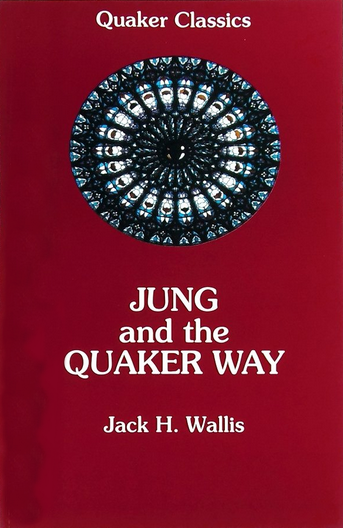
  • Jung and the Quaker Way by Jack H. Wallis (289.6092 WAL)

              If you’re familiar with Quaker practice, but not with the psychological principles of Carl Jung, this book is a good introduction to Jung, as well as being an interesting perspective on the intersection of his principles with Quakerism.  Jung, like Quakers, believed “that any true religion should be founded on experience, not on dogma, doctrine or a dutiful faith.” Jung had little interest in theology, but an intense interest in religion.  He maintained, as Wallis says, that it is “the province of religion and psychology to work together in helping individuals towards integration, balance, and wholeness.” Wallis, via Jung, focuses on the needs and experiences of the individual — Jung, like George Fox, maintained that “we cannot understand a thing until we have experienced it inwardly,” as well as on the needs of the group, pointing out that the spiritual viability of a group, such as Quaker meeting for worship, depends on the self-awareness of each individual.  This requires, among other things, the individual’s awareness of their Shadow, which Jung describes as “the negative side of the personality, the sum of all those unpleasant qualities we like to hide.”

              Referring to group dynamics, Wallis, citing John MacMurray, a Quaker academic and moral philosopher, explains the difference between Functional relations that exist for a practical purpose, such as in a workplace, and Personal relations, which are “independent of any particular function.  The intersection of the Functional and the Personal is important, in that “responsibility rests ultimately not on dogma or rules but on feelings, on goodwill, and on response to the needs and sufferings of others and a sense of their intrinsic value as individuals.” That being said, Wallis suggests a third kind of relationship — the spiritual, which involves a numinous quality.

              Quakers often refer to the inward leading, or inward light; Jung talks of this in terms of a personal vocation, suggesting that one who listens to the inward voice is “called.” He believed that to become a personality, to be “individuated,” it was crucial to assent consciously “to the power of the inner voice […] That is the great and liberating thing about any genuine personality: he [sic] voluntarily sacrifices himself to his vocation.” Jung warns us, though, about the need to be aware of our various personae, which are the roles we adopt in order to fit in with conventional norms; he warns that we must not surrender our true selves to these roles.  “The persona,” says Jung, “is that which in reality we are not, but which in our own and other people’s opinion, we are.”

              In terms of the development of the individual, Jung believes “that the true goal of human development is not perfection (in the religious, moral, or spiritual sense), but wholeness.” Wallis points out that wholeness as a goal “is valid at all stages of life, a child should be a child, an adult should be an adult, an old person should be an old person and not an imitation young one.  Each of us should seek the personal wholeness that is our own unique identity of mind, body, psyche, and soul.” It is this personal wholeness upon which a meeting for worship depends for its communal wholeness.

              Balance and stability, both in the individual and in the group, depend, according to Jung, on the tension of opposites: opposing points of view, opposing needs or desire in the individual as well as in the group, opposing goals.  “Every good meeting,” says Wallis, “has within it some spontaneous tension arising from the awareness of opposites.  It is a tension of growth and insight, not of antagonism, competition, or rivalry.”

              Wallis addresses images of God and of Jesus, referring primarily to Janet Scott’s 1980 Swarthmore lecture entitled What Canst Thou Say? Scott says that “what we say [about God] is provisional, symbolic, and metaphorical.  So that when we speak of God in a personal way we do not mean that God is a person, only that personal language is the best way we have to express an inexpressible relation.”

              If you have time to read only one chapter of the book, I suggest the last one, “A Reasonable Faith.” Though Wallis does not reference it, this was the title of a book published anonymously in 1884.  The anonymous authors, originally cited as “Three Friends,” were later revealed to be three Quakers: William Pollard, Francis Frith, and William Z. Turner.  This final chapter of the book is a well-articulated summary of the intersection of Jung’s principles of psychology with Quakerism.  As Wallis writes, “Much of what [Jung] wrote is in harmony with the Quaker way, for instance his belief that religion should be founded on experience, at first hand rather than on dogma or doctrine; that no one can tolerate a life devoid of meaning; that the spiritual part of us is as real as the physical, the emotional, and the intellectual; that our inner life is as important as our outer experience; that a working harmony of differences and opposites is a mature achievement and a sign of psychological health; that an inner voice prompts us and an inner light guides us towards our personal vocation; that God is present in all human nature as well as transcendent; that faith and practice are two expressions of the same reality — our human responsibility.”

  • On Tyranny: Twenty Lessons from the Twentieth Century By Timothy Snyder (321.9 SNY)

    Reviewed by Matthew Manera.

    Though this book was published in 2017 and deals with the aftermath of Trump’s election in 2016, it applies just as well, perhaps even more so, to where we are in 2025. Snyder begins with a Prologue on History and Tyranny to set the stage for the rest of the book.

    The second of these twenty lessons is “Defend Institutions,” in which he writes, “The mistake is to assume that rulers who came to power through institutions cannot change or destroy those very institutions—even when that is exactly what they have announced that they will do.”

    In the chapter “Beware the one-party state,” he quotes the American abolitionist Wendell Phillips, who said that “eternal vigilance is the price of liberty,” adding that “the manna of popular liberty must be gathered each day or it is rotten.” This is a reference to Exodus 16:4 ff—check it out. With regard to safeguarding the electoral system, Snyder says, “We need paper ballots, because they cannot be tampered with remotely and can always be recounted.”

    Concerning professional ethics, he writes, “Professional ethics must guide us precisely when we are told that the [political] situation is exceptional.  Then there is no such thing as ‘just following orders.’ If members of the professions [especially politicians and lawyers] confuse their specific ethics with the emotions of the moment […] they can find themselves saying and doing things that they might previously have thought unimaginable.”

    In another chapter, “Stand Out,” he says, “Someone has to.  It is easy to follow along.  It can feel strange to do or say something different.  But without that unease, there is no freedom.  Remember Rosa Parks. The moment you set an example, the spell of the status quo is broken, and others will follow.”

    “Be kind to our language” advises us to “avoid pronouncing the phrases everyone else does.  Think up your own way of speaking, even if only to convey that thing you think everyone is saying.  Make an effort to separate yourself from the internet.  Read books.” “Politicians in our times,” he continues, “feed their clichés to television, where even those who wish to disagree repeat them. […] Everything happens fast, but nothing actually happens.  Each story on televised news is ‘breaking’ until it is displaced by the next one.  So we are hit by wave upon wave but never see the ocean.” He also refers to the suppression of books and the narrowing of vocabularies, and “the associated difficulties of thought.” Snyder advises us to “get the screens out of your room and surround yourself with books.”

    “Believe in truth,” he writes.  “To abandon facts is to abandon freedom.  If nothing is true, then no one can criticize power, because there is no basis upon which to do so.  If nothing is true, then all is spectacle.  The biggest wallet pays for the most blinding lights.” “You submit to tyranny when you renounce the difference between what you want to hear and what is actually the case.”

    In the chapter “Investigate,” Snyder encourages us to “figure things out for yourself” and to “take responsibility for what you communicate with others.” “It is your ability to discern facts that makes you an individual, and our collective trust in common knowledge that makes us a society. The individual who investigates is also the citizen who builds.  The leader who dislikes the investigators is a potential tyrant.”

    Snyder argues that we must “Practice corporeal politics—power wants your body softening in your chair and your emotions dissipating on the screen.  Get outside.  Put your body in unfamiliar places with unfamiliar people.  Make new friends and march with them.”

    These are only a few of the lessons about which Snyder writes.  The book is easy to read—only 125 pages in a 4-inch by 6-inch edition.

  • Review: Friends for 300 Years by Howard H. Brinton (289.6 BRI)

    Reviewed by Matthew Manera.

    Brinton’s overview of Quakerism, unlike Elfrida Vipont’s The Story of Quakerism 1652-1952 and Ben Pink Dandelion’s An Introduction to Quakerism, “is not”, as Brinton says in his Introduction, “to produce a history of Quakerism, but, by means of historical illustrations, to examine a method.” In this way, it is a useful complement to these two books. Brinton examines early Quakerism by focusing on George Fox’s pastoral Epistles and Robert Barclay’s Apology, the former portraying “Quakerism as felt,” or experienced; the latter portraying “Quakerism as thought about.”

    I’m trusting that those of you who read this are familiar with the basic historical facts of early Quakerism, and so will move quickly over the first three chapters, “To Wait Upon the Lord,” “The Light Within as Experienced,” and “The Light Within as Thought About.” Brinton explains how Quakers sought a religion based on the Spirit within, rather than on externally imposed forms and disciplines, how the Light Within or Spirit “was primary and the Scriptures a word of God” which is secondary and serves to “[confirm] and [clarify] the revelations of the Light Within”; he quotes Margaret Fell quoting George Fox —”You will say, Christ saith this, and the apostles say this; but what canst thou say?”; and mentions how the Light was to be realized in experience rather than in theory by “answering.” As Fox wrote, “Be faithful and spread the Truth abroad and walk in the Wisdom of God answering that of God in every one.” Brinton also distinguishes how Fox, as prophet, followed the Hebrew tradition, “bearing witness to the personal God whose prophets are instruments through which He utters his voice and works his will,” and how he, as philosopher, “followed the Hellenic tradition, apprehending the inner Unity which exists beyond time and space, Real as compared with the phenomenal world, One, as contrasted with the multiplicity recognized by the senses.”

    Brinton also distinguishes between the Eternal Christ and the Historic Jesus, the former being the Light Within that is a part of every person, so that, as Fox writes, “we are regenerated, not so much by the death of Christ [the Historic Jesus], as by his life in our hearts.” He addresses the idea of Perfectionism, which Barclay was careful to explain: “Perfection means simply living up to the measure of light that is given [to each of us], and if we are faithful to that, we shall be given more.” Brinton concludes the first three chapters with this: “In Quakerism there are two complementary movements, withdrawal to an inward Source of Truth and return to action in the world.  The first is Greek in its religious emphasis, the second, Hebrew.  Quakerism is both contemplative and active, both metaphysical and ethical, not because it has combined the two in a consistent system of thought, but because it has combined them through experience.”

    In discussing the Meeting for Worship, Brinton observes, “As Catholic worship is centered in the altar and Protestant worship in the sermon, worship for the Society of Friends attempts to realize as its center the divine Presence revealed within,” which involves the idea of withdrawal and return mentioned above: “In worship we center our attention on that which is deeper than discursive thought.” Meetings for Worship involve a measure of vocal ministry, and what Brinton has to say about this should speak to us today: “Ministry in a Friends meeting should be spontaneous in the sense that no one comes to meeting either expecting to speak or expecting not to speak.” “The first-person singular pronoun is seldom heard in Quaker ministry, nor does the speaker declare his own experience except as his experience may illustrate a more general truth.” The speaker should “learn to recognize and reject the wish to speak which comes from a different source [than the Spirit], however disguised, such as an inclination to exhibit his own powers or knowledge or simply lack of inhibition.”

    Writing of how Quakers reach decisions, Brinton says, “the meeting is to act as a whole and be governed by Truth, not by persons appointed to rule.” Distinguishing meeting for worship from meeting for business, he says, “the meeting for worship concerns being, while the meeting for business concerns doing.” Meetings for business, in making decisions for moving forward on any issue, depend on all voices being heard and on consensus, rather than on compromise: “At its best, the Quaker method does not result in compromise [which] is not likely to satisfy anyone completely.  The objective of the Quaker method is to discover Truth which will satisfy everyone more fully than did any position previously held.” Neither is unity to be equated with uniformity: “Unity is spiritual, uniformity mechanical.” Ideally, anyone who speaks in meeting for business will begin with “I feel,” rather than “I think,” feeling being the “intuitive apprehension of the Light of Truth.” That being said, he points out that the Quaker method works better in small rather than large groups, and that it “is likely to be successful in proportion as the members are acquainted with one another; better still if real affection exists among them.” As for the origin of social concerns in Quakerism, Brinton says that the focus in this area has to do with Community, Harmony, Equality, and Simplicity.

    In terms of the intersection of the Meeting and the World, Brinton describes Quaker work among Negro slaves and Indians [designations Brinton uses throughout his book], as well as the non-violent approaches they took towards those in prisons, beginning with the work of Elizabeth Fry in England in 1813, and towards those in mental hospitals, where the first such hospital in the United States to work with Quaker principles, the Pennsylvania Hospital in Philadelphia, founded in 1756, “was the first institution where cure rather than custody and repression was the underlying principle in the treatment of the insane.”

    As for the reason for the Quaker peace testimony, Brinton says of soldiers that “the soldier who is killed suffers a material injury; the soldier who kills suffers a spiritual injury.” Relief work, “undertaken to repair damages caused by war or conflict is a natural corollary of the peace principle.  Its beginnings go back to the Irish war in 1690, and the banishment of Acadians from Canada in 1755, and continue through to the establishment of the American Friends Service Committee in 1917 during the first World War.  A follow-up to Brinton’s book, Friends for 350 Years (289.6 BRI), was published in 2002, with a historical update and notes by Margaret Hope Bacon, tracing the developments in Quakerism, especially in America, between 1952 and 2002.

  • International Day of Peace (Sat Sep 20 4-6:30)

    International Day of Peace Sept 20, 2025 | 4-6:30 PM

    Join us for an intergenerational, family-friendly event, featuring crafts, conversations, and a shared, simple meal (potluck contributions welcome).Victoria Friends Meeting House1831 Fern St, Victoria, BC

  • World Quaker Day Sunday Oct 5, 2025

    World Quaker Day
Love Your Neighbour
Multilingual version

Can you identify the languages?

    Quakers exist around the world! What languages can you see?

    At 12:15 on Sunday October 5th we will show a documentary film about the World Plenary Meeting held in South Africa in August 2024. It will open our eyes to the practices of Friends globally. The film is 60 minutes and will be followed by discussion.

    Please invite your friends and neighbours to join us for Meeting for Worship and/or the film presentation.

    Please bring a bag lunch to munch during the film.

    More information

    Friends World Committee for Consultation (FWCC) is a global group that builds and maintains bridges between the main branches of Quakerism. It was founded in the 1920s in response to the nineteenth century schisms which divided Quakers along doctrinal, worldly, and liturgical fault lines.

    The Friends World Committee for Consultation encourages fellowship and understanding among all the branches of the Religious Society of Friends.

    We bring Quakers together in multiple ways to celebrate God in our lives, to gather the Quaker voice, build networks to address issues of our time, and to unite Friends within our diversity

    https://fwcc.world
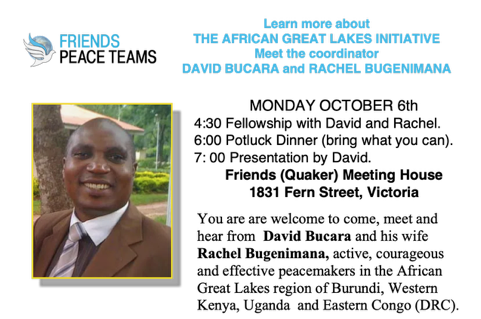
  • David Bucara and Rachel Bugenimana Monday Oct 6, 2025

    David Bucara and Rachel Bugenimana Monday Oct 6, 2025

    MONDAY OCTOBER 6th

    4:30 Fellowship with David and Rachel.

    6:00 Potluck Dinner (bring what you can).

    7: 00 Presentation by David.

    Friends (Quaker) Meeting House

    1831 Fern Street, VictoriaYou are are welcome to come, meet and hear from  David Bucara and his wife Rachel Bugenimana, active, courageous and effective peacemakers in the African Great Lakes region of Burundi, Western Kenya, Uganda  and Eastern Congo (DRC).

    David is Coordinator of the African Great Lakes Initiative (AGLI) of the Friends Peace Teams. He has long experience as a pastor, peacemaker, and educator, with degrees in education, theology and leadership.  He and his wife Rachel Bugenimana live in Kigali, Rwanda. They have three children, two daughters and one boy.

    Along with working with AGLI since its inception in 1999 and Coordinator of the Friends Peace Team/AGLI for the last six years, he is Deputy of the Peace and Development Network in Rwanda. He is a Friends World Committee for Consultaton (FWCC) Africa Section representative to the work of the Quaker United Nations Office in Geneva.  David has served as General Secretary and General Superintendent of Rwanda Yearly Meeting.  He was the first director of Peace House, a Quaker-inspired center for interfaith and interethnic reconciliation started the year after the genocide in Rwanda in 1994.  

  • Fall WHYM Oct 10-12, 2025 Camp Kannawin, AB

    Registration for Fall Western Half-Yearly Meeting (WHYM) Gathering from October 10-12th at Camp Kannawin, AB, is now open and available here for the in-person gathering. Please register as soon as possible! If you have questions regarding registration, please contact the registrar at: whymregistrar@gmail.com

    More information is available here.

    A link for online participation in the Saturday evening activity and Meeting for Worship for Business will be shared closer to the gathering.

    For financial support please ask Vancouver Island Finance Committee first, and the WHYM Finance Committee onsite.