Matthew Manera’s Review of This is Real and You Are Completely Unprepared. The Days of Awe as a Journey of Transformation by Rabbi Alan Lew (296.43 LEW)
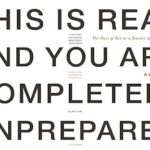
At first glance, this is a book about the Jewish High Holidays, and, of course, it is. But though it addresses the specific holidays, from Tisha B’Av [the day of mourning for the destruction of the Temple in Jerusalem] to Sukkot [the autumnal harvest festival], it speaks to anyone who is concerned with spiritual transformation.
All significant religious texts will overlap in some degree when it comes to the most substantial understanding of what the relationship between the human and the divine, or between a disciple and a teacher, is (Rabbi Alan Lew, before becoming a Rabbi, spent ten years as a committed practitioner of Zen Buddhist meditation). For example, in the Bhagavad Gita, Krishna says to Arjuna, “No matter by what path men approach Me [you can read “Me” to be your own understanding of God], they are made welcome. For all paths no matter how diverse lead straight to Me. All paths are mine, notwithstanding by what names they may be called.” And when the Buddha was addressing the inhabitants of the small town of Kesaputta, he said, “Now, look you Kalamas, do not be led by reports of religious texts, nor by mere logic or inference, nor by considering appearances, nor by the delight in speculative opinions, nor by seeming possibilities, nor by the idea: ‘this is our teacher.’ But, O Kalamas, when you know by yourselves that certain things are unwholesome and wrong and bad, then give them up […] And when you know for yourselves that certain things are wholesome and good, then accept them and follow them.” This reminds me of two passages from George Fox’s Journals: he said about his faith, “And this I knew experimentally,” and about the teachings of Christ, “You will say, Christ saith this, and the apostles say this; but what canst thou say?”
Here are some passages (some quoted directly; some paraphrased) from the book that might entice you into engaging in a dialogue with it:
• Spiritual practice will not change what happens to us; rather, it will change us.
• [with reference to being called to account for our actions, feeling that we are ready and confident to do so, but finding that we are, unexpectedly, completely unprepared] “And [this sense of being completely unprepared] is real whether you believe in God or not. Perhaps God made it real and perhaps God did not. Perhaps God created this pageant of judgment and choice, of transformation, of life and death. Perhaps God created the Book of Life and the Book of Death, Teshuvah and the blowing of the shofar. Or perhaps these are all just inventions of human culture. It makes no difference. It is equally real in any case.”
• “Perhaps God made the reality that all this human culture seeks to articulate. Perhaps God made a profoundly mixed world, a world in which every second confronts us with a choice between blessings and curses, life and death; a world in which our choices have indelible consequences; a world in which life and death, blessings and curses, choose us, seek us, find us every moment. And we live with the consequences of our choices. And perhaps we have chosen arbitrary spiritual language to express these things, or perhaps God made human culture so that we would express these things precisely as we have in every detail. It makes no difference. What makes a difference is that it’s real and it is happening right now and it is happening to us, and it is utterly inescapable, and we are completely unprepared. This moment is before us with its choices, and the consequences of our past choices are before us, as is the possibility of our transformation.”
• “The first thing we do during the High Holidays is come together; we stand together before God as a single spiritual unit. […] We heal one another by being together. We give each other hope.”
• “Most of us only embark on the difficult and wrenching path of transformation when we feel we have no choice but to do so, when we feel as if our backs are to the wall, when the circumstances of our lives have pushed us to the point of a significant leave-taking, when we have suffered loss or death, divorce or unemployment. Transformation is just too hard for us to volunteer for. […] We are in the predicament that has brought us to the point of transformation because God has driven us there. In other words, that predicament is part of the process. It is a gift, the agent of our turning. […] Transformation is not something that happens once and for all time. […] Transformation does not have a beginning, a middle, or an end. […] And it may never be clear to us that the work of transformation has borne fruit […] Real spiritual transformation invariably takes a long time to manifest itself in our lives.”
• [Lew quotes from Shunryu Suzuki, in his book Zen Mind, Beginner’s Mind] “If your mind is empty, it is always ready for anything; it is open to everything. n the beginner’s mind there are many possibilities; in the expert’s mind there are few […] In the beginner’s mind there is no thought, ‘I have attained something.’ All self-centred thoughts limit our vast mind. When we have no thoughts of achievement, no thought of self, we are true beginners.”
• “Every spiritual tradition I am aware of speaks of a kind of layered mindfulness, a sensibility that works up and out of the body, to the heart and then to the mind and then finally to the soul. The Buddhist sutra On Mindfulness describes this kind of layered grid of awareness, and the Kabala, the Jewish mystical tradition, speaks of it too.”
• “None of us is whole by ourselves. A spiritual community is one in which we find wholeness, completion with others. What we lack is provided by somebody else.”
• [on death] “We are born and we die, and nothing that happens in between is nearly as important as these two fundamental facts of life. […] Once life is over, it is clear that it has taken up no time or space at all. […] What lives on of the people we have loved and lost? What breaks our hearts when we think of them? What do we miss so much that it aches? Precisely that suchness, that unspeakable, ineffable, intangible quality, which takes up no space at all and which never did.”
• “What is the core of our life? Are we living by it? Are we moving toward it? We shouldn’t wait until the moment of our death to seek the answers. At the moment of death, there may be nothing we can do about it but feel regret. But if we seek answers now, we can act in the coming year to bring ourselves closer to our core.”
• “We can’t control sickness, old age, or death. We are terrified of them. But as Sharon Salzberg asks, what would we fear if we experienced ourselves to be part of the whole of nature, moving and changing, being born and dying? What would we fear if we understood that our bodies were joined with the planet in a continual, rhythmic exchange of matter and energy?”
• “Joy is a deep release of the soul, and it includes death and pain. Joy is any feeling fully felt, any experience we give our whole being to.”
• “Every moment of my life, I am inescapably hammered into place by everything that has ever happened since the creation of the universe, and every moment I am free to act in a way that will alter the course of that great flow of being forever.”