Matthew Manera’s Review of “Barclay’s Apology in Modern English (289.6 BAR)” July 2025
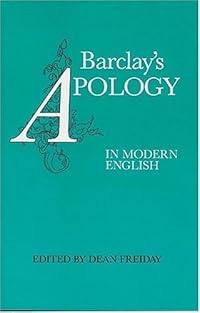
“What I have written comes more from what I have heard with the ears of my soul. I have declared what my inward eyes have seen and what my hands have handled of the Word of Life. It is what has been inwardly manifested to me of the things of God.” So writes Robert Barclay at the beginning of his Apology, which consists of fifteen theological theses, or propositions, published in 1676 in Latin, then in English in 1678. It should be noted that this edition of the Apology is rendered into modern English by Dean Freiday and is an abridged and edited edition, which some scholars have criticized in parts for misrepresentation of Barclay’s ideas. Barclay makes many references to Christ, which, given the beginnings of Quakerism in the Christian tradition, is inescapable. However, for those Quakers who do not consider themselves bound by the Christian tradition, one can read “Christ” as “Spirit,” and still find these propositions speak to their condition.
Proposition 1, “The True Foundation of Knowledge,” serves as an introduction to the following fourteen propositions: “Since the height of all happiness is the true knowledge of God, it is primary and essential that this foundation of knowledge be properly understood and believed.”
In Proposition 2: “Inward and Unmediated Revelation,” Barclay insists that divine inward revelations and inward illuminations are “absolutely necessary for the building up of true faith” and “possess their own clarity and serve as their own evidence.”
As for the Scriptures, which he addresses in Proposition 3, they are “only a declaration of the source, and not the source itself” and “are not to be considered the principal foundation of all truth and knowledge,” but only “as a secondary rule that is subordinate to the Spirit.”
In Proposition 4, “The Condition of Man in the Fall,” Barclay argues against the Augustinian-based concept of original sin, writing that “we do not impute the evil seed to infants until they have actually been joined to it by their own transgression.”
Freiday puts Propositions 5 and 6 (“The Universal Redemption by Christ, and also the Saving and Spiritual Light by which Every Man is Enlightened”) together in one chapter. Proposition 5 refers to the Fall of Man (Proposition 4) by pointing out “the real light which enlightens every man,” which is Christ, and according to John 1:9, “is no less universal than the seed of sin, being purchased by his death who tasted death for everyone.” In Proposition 6, Barclay argues that “the universality of Christ’s saving death” is available to everyone in every time: “Just as many of the ancient philosophers may have been saved, so may some of those today whom providence has placed in remote parts of the world where the knowledge of history [i.e. the historical Jesus] is lacking, be made partakers of the divine mystery if they do not resist the manifestation of grace which is given to everyone for his benefit. […] The benefit of [Christ’s] suffering is extended not only to those who have a well-defined outward knowledge of his death and sufferings, […] but even to those who by some unavoidable accident were excluded from the benefit of this knowledge.”
Proposition 7 deals with Justification, which Barclay defines as “the formation of Christ within us, from which good works follow as naturally as fruit from a fruitful tree.” We are justified, therefore, “not by works produced by our own wills, or by good works themselves, but by Christ, who is not only the gift and the giver, but the cause which produces these effects in us.”
Perfection [or The Achievement of Spiritual Maturity] is the theme of Proposition 8. Barclay makes clear that by Perfection, he means something “that is proportional to a man’s requirements.” When, in this state of relative perfection, one “is no longer able to obey any suggestions or temptations toward evil, but is freed from sin and the transgression of the law of God, and in that respect is perfect.”
Proposition 9, “Perseverance in the Faith and the Possibility of Falling from Grace,” is the consequent counterpart to Proposition 8, in that “even though this gift of the inward grace of God is sufficient to bring about salvation, yet for those who resist it, it not only may become their condemnation, but does. […] Nevertheless, it is possible to achieve […] an increase and stability in the truth in this life that total apostasy is impossible.”
Ministry, the subject of Proposition 10, presents Barclay’s, and Quakers’, understanding of how ministry should be understood: “Every evangelist and every Christian pastor ought to be led and directed in his labour in the work of the gospel by the leadings, motions, and drawings of God’s light. These should govern not only the place where, but the persons to whom he speaks, and the time when he should speak. […] Those who have received this holy and unspotted gift [of ministering] have received it without cost and should give it without charge.” One should keep in mind that, at the time Barclay is writing, itinerant ministers, especially among Quakers, were common.
In Proposition 11, “Worship,” Barclay writes of all those Quakers who are not called to be itinerant ministers, while hearkening back to the subject of Proposition 2: “True and acceptable worship of God stems from the inward and unmediated moving and drawing of his own Spirit. It is not limited by places, times, or persons. […] We should be moved by the secret stimulation and inspiration which the Spirit of God provides in our hearts.”
Barclay addresses Baptism in Proposition 12, by citing Ephesians 4:5 and 1 Peter 3:21: “Just as there is ‘one Lord, and one faith,’ so is there ‘one baptism,’ which is ‘an appeal to God for a clear conscience, through the resurrection of Jesus Christ.’” He points out, as well, that “the baptism of infants, however, is [unlike the figurative baptism of John] a mere human tradition, for which neither precept nor practice is to be found anywhere in scripture.”
Communion, another of the Christian sacraments, like Baptism, is the subject of Proposition 12: “The communion of the body and blood of Christ is inward and spiritual. It is by participation in his flesh and blood that the inward man is nourished daily in the hearts of those in whom Christ dwells.”
Proposition 14, “Concerning Civil Power [“the power of the Civil Magistrate” in the original] in Matters Purely Religious and Pertaining to the Conscience,” argues that one’s own conscience, derived from God, is to be regarded more highly than any civil power: “The power and dominion of the conscience are the province of God, and he alone can properly instruct and govern it. No one whatsoever may lawfully force the consciences of others regardless of the authority or office he bears in the government of this world.” That being said, this is “always subject to the provision that no man, under pretense of conscience, may prejudice the life or property of his neighbour, or do anything that is destructive to human society or inconsistent with its welfare.”
Lastly, Proposition 15 deals with “Vain and Empty Customs and Pursuits.” “The chief purpose of all religion,” writes Barclay, “is to redeem men from the spirit and vain pursuits of this world, and to lead them into inward communion with God. All vain and empty customs and habits [for example, “taking one’s hat off to another person, bowing or cringing], whether of word or deed, should be rejected by those who have come to fear the Lord [fear being understood as awe].”